
The serialised version of Smuggling Times and the truth behind the tales
A Matter of Transport
Throughout the 18th Century legislation to support the prevention of smuggling burgeoned, primarily targeting those landing and transporting the goods. Incentives offered leniency and pardons to those who informed. This escalated the violence among criminal gangs involved in the trade as an informer could walk free by giving up his fellow smugglers to a potential death sentence or, if they were able seafaring men, being pressed for the Navy.
As Captain Jewell repaired his boat, a smuggler named Garrett in Lincoln gaol began to provide a startling amount of information. He first implicated a number of people along the Lincolnshire coast but then began demanding money (ten guineas) to provide further details. A London solicitor, acting for the Customs’ Board, rejected the offer but numerous prosecutions along the coast were undertaken on Garrett’s information including:
Bancroft (tailor) of Nth Somercotes & Oliver (mariner) of Theddlethorpe unshipped 300 pounds of tea & 150 gallons brandy.
Hubbard (mariner) of North Somercotes was named as involved in the above.
Bell (mariner) No Location- [likely Theddlethorpe] unshipped 2,000 pounds of tea.
Three sloops were also declared seizable when found, including that of Richard Burleigh, Captain of the Thunderbolt. Burleigh was a notorious smuggler previously imprisoned in Dover Castle for the murder of John Wood, a Customs officer at Newhaven. Burleigh had escaped in March 1737 and was known to be on the Lincolnshire coast. Garrett continued to name others along the East Coast, offering details on “two men of fortune and estate” who had recently unshipped 1600 pounds of tea, this time he requested twenty guineas and was again refused.
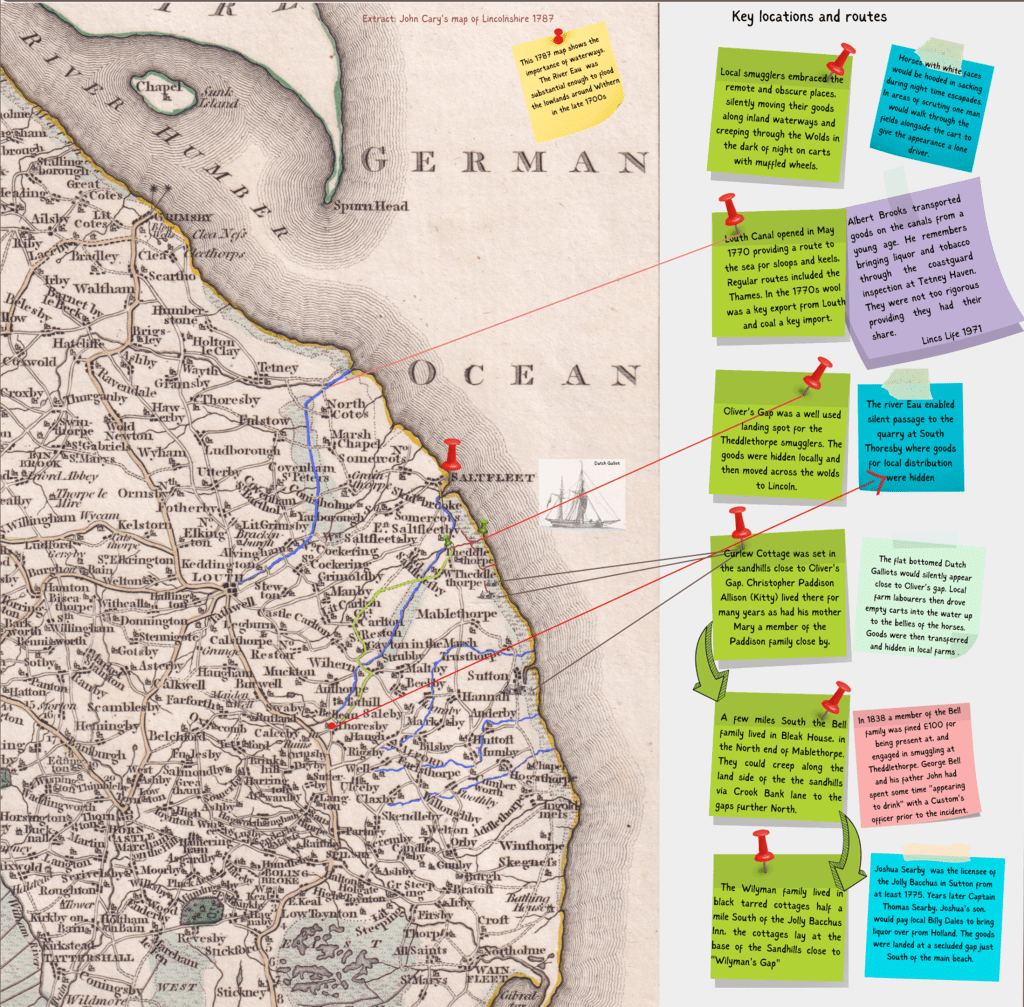
The Bell and Oliver families were renowned along the Theddlethorpe coast across the generations. These seafaring families landed their goods via the “gaps” in the sand dunes using horses and carts to transport the contraband to safe houses and hiding places. The gaps became branded by their notorious users, Oliver’s gap lay close to Saltfleet Haven and ironically appeared on some Admiralty maps. Local mariners had been trading with the low countries for hundreds of years out of Saltfleet. In 1771 the Complete English Traveller descibed the harbour Saltfleet as … pleasantly situated on the German Ocean, formerly a place of some trade. It has still a harbour for shipping but it is suffered to fall to decay, there being no ships that use it above the ordinary size of lighters. However, trade continued for many years, the efficiencies of Dutch merchants grew. Warehouses were set up on the continent to receive English wool and provide specially packaged contraband, for ease of concealment and transportation, upon return. The Customs men were not the only problem the mariners faced.
The Press Gang

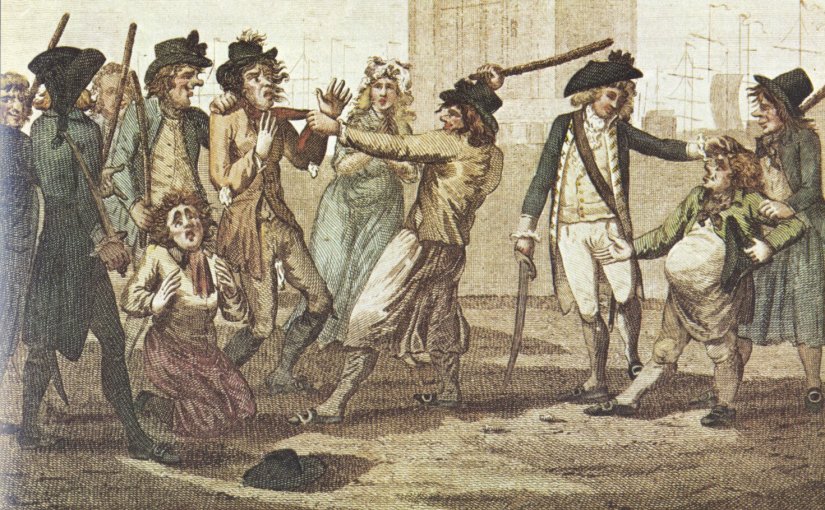
During the wars of the 18th century seafaring men were an important commodity to the Country. Press gangs operated in harbour towns throughout the Nation, using local men and physical persuasion to force mariners to do their bidding. Many merchant sailors returning home, including captives recently freed from French prisons, found themselves unwillingly serving in the Royal Navy. During Jewell’s suspension the crew of his sloop mutinied in his support, they were all immediately pressed for the Navy.
In May 1804 five men were sentenced to three months in Lincoln Gaol as ring leaders against the “Press Men” in Boston. An assembly of over 200 people had attacked the Press Gang with extreme violence, using bats and stones rendering some unconscious. The Judge observed that:
… those people who constituted what were called press gangs were involved in a service, the object of which was the protection and preservation of the Country. As long as it was necessary to have fleets and sailors for the defence of the realm, so long would it be necessary to have press gangs. The law allowed them and whoever interrupted them was guilty of a gross violation of the war.
By 1804 twenty seven year old Robert Button of Farlesthorpe had already fallen foul of the the press gang. At fifteen Robert began working at the Red Lion, Church street, in Alford, where he remained for a couple of years before going to sea aged eighteen seeking excitement. After three years serving on different merchant vessels Robert had seen enough, his indenture papers were lost and he quit life at sea. HIs decision proved to be short lived, strong armed back to sea by a press gang. It would be another three years before he would return to Alford, serving instead on a Man of War for the Navy. Poor law papers reveal that Robert Button was not the only mariner to have settled in Alford.
Robert Peelings from Partney had been bound by Parish officers as an apprentice to a cordwainer at the age of 8 in 1784. Officially tied until the age of 21 the young man had run away to sea aged 17. Robert served until he was discharged in 1805 having lost a leg, he was now an “out pensioner” of Chelsea. In 1814 at the age of 38 Robert Peelings was once again reliant on Parish officers for a place of settlement.
Keeping it in the family
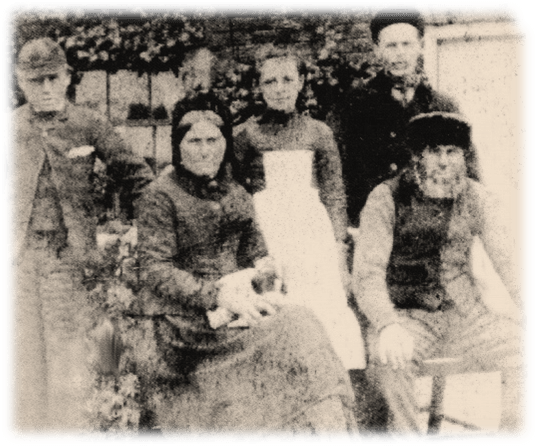
courtesy of Rachel Morton
A few miles down the road another “out pensioner” of Chelsea, a soldier, returned to his birthplace at Belleau.
Daniel Paddison was the son of paupers William and Mary Paddison, he had worked as a labourer before joining the 5th Foot Regiment in 1803. Wounded by a musket shot in his right thigh at the Battle of Salamanca (1812) Daniel Paddison was finally discharged in 1816 at the age of 31.
In November 1821 Joseph Bland, a labourer from Belleau, was sentenced to transportation for 7 years for theft. Daniel Paddison was the victim, court papers record him as a labourer. The stolen items were a man’s coat, a woman’s great coat, a cotton hankerchief, cotton braces and cord breeches. Despite his injuries Daniel Paddison appears to have been able to supplement his pension and obtain items his peers coveted. In later years the musket ball wound would be cited as the cause of his death so hard manual work and the poor pay rates of a labourer seem unlikely to be the source of Daniel’s extra income. Family connections suggest an alternative income stream as his sisters had married into the smuggling families of Sutton in the Marsh.
Sarah Paddison married Robert Wilyman (b. 1784) in Belleau in 1815, with Daniel’s brother Richard as a witness at the wedding. Their son Robert Wilyman (b.1826) married Sarah Bell, daughter of Edward (Ned) Bell in 1849. The couple would go on to have sixteen children, eight of the nine boys were seafaring men.
Edward Bell of Bleak House, Mablethorpe, was the eldest son of fisherman John Bell of Theddlethorpe. Active in the years of deceipt and concealment, which followed the violence of the 18th Century, farmer Ned Bell gained notoriety with numerous mentions in 20th Century Publications.

The Wilyman family lived in black tarred cottages at the top of Church Lane in Sutton, close to Wilyman’s Gap.
A young curate, William Bompas, was a neighbour of the Wilyman’s, in his later years as a Bishop he would reminisce about his days living among Sutton’s smugglers.
In 1801 Thomas Frow, a well known Mablethorpe innkeeper of the time, was a witness at a Wilyman wedding.
The Jolly Bacchus
Daniel Paddison’s elder sister Jane had married Captain Thomas Searby in 1814, the landlord of the Jolly Bacchus in Sutton Le Marsh. The 17th century inn had been in the hands of his family since at least 1792. Thomas took over after many years at sea, remaining in his post until he died in September 1852 aged 74.

A few weeks later Joseph Mason and his wife Ellen left the Victoria Hotel in Alford to run the Jolly Bacchus, Ellen was Daniel Paddison’s daughter.
One 19th century travel writer who stayed at the inn makes a tongue in cheek reference to his night at the Jolly Tobaccos, also remarking on the men and horses working hard to unload a coal brig in the moonlight. These collier vessels which plied their trade along the coast line were frequently connected to smuggling having other goods hidden beneath the coal. Thomas Searby is also listed in some trade directories as a coal merchant. Some years later diary extracts were published from the diary of a young man who fell in with smugglers in Sutton in the 1840s; the rogues and drunkards the young man fell in with passed their time at the inn.
Influential wealthy families intermarried to protect their own interests, in the same manner the free traders cemented bonds of trust and kept their secrets safe. Marriage between the families ensured that Jane and Sarah Paddison were well protected from the interference of Parish officers. As Belleau sits on the route taken across the Wolds by those moving the contraband from Theddlethorpe to Lincoln, Daniel and Richard Paddison were quite literally in a position to help.
 About Alford