

In January 1914 an elderly man lost his fight for life on Finsbury Street in Alford, just a few miles from his birthplace in Willoughby. Heart failure and old age had finally got the upper hand, his death certificate recorded his age as 88, his profession a “pensioned Police Constable of the City Police in Vancouver, British Columbia”. Neither of these things are completely accurate but they are not too far from the truth and that would have been good enough for John Clough. One short entry confirmed his passing in the Boston Guardian.
One month later the Board of Police Commissioners in Vancouver also noted the passing of John Clough, and in Vancouver Old John was very well remembered. In fact a bar and club were named after him.

John Clough spent most of his life in North America and Canada, he drove cattle across the prairies, panned for gold, and worked on the Canadian Pacific Railway (CPR) as they blasted tunnels and built bridges across the Canadian Rockies in the push to complete the connection to the West Coast. By 1886 he was in a small township newly incorporated as Vancouver, the final location on the new rail line and a hive of activity, chaos and expectation. After all of his adventures circumstances now forced John Clough to find a different life and begin his final chapter.
Vancouver
The small township of Granville would be incorporated as Vancouver in April 1886. During John Clough’s time tree stumps remained among the new buildings and speculators grabbed the lots for sale while the railway construction workers set fires to clear the forests beyond.
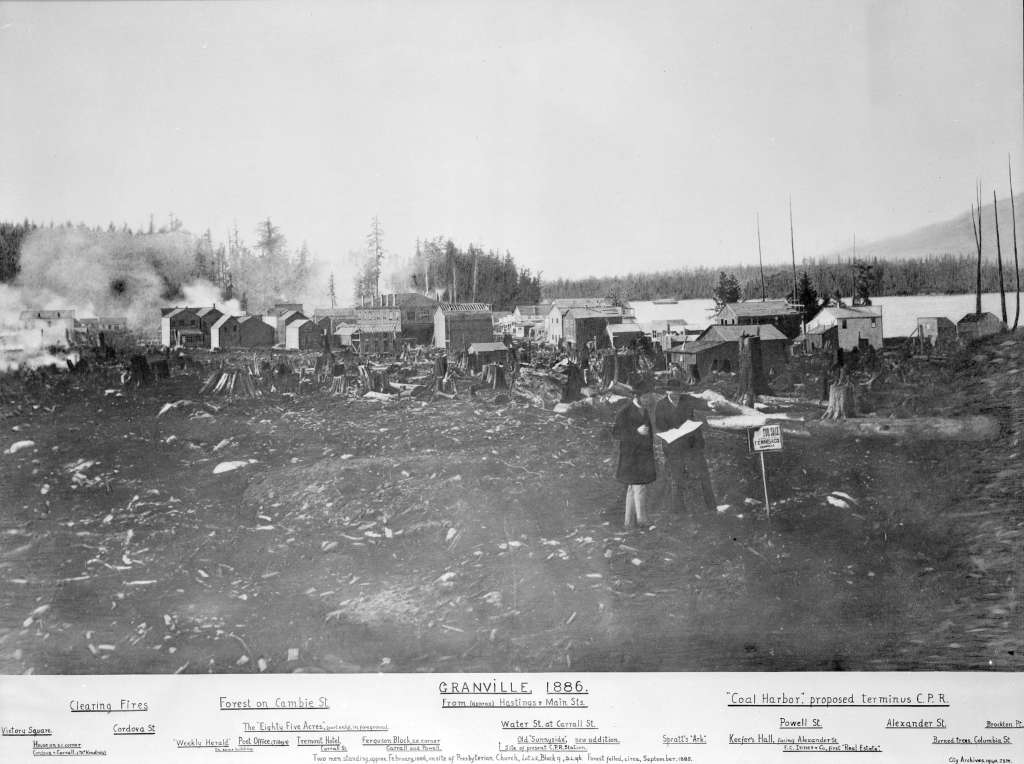
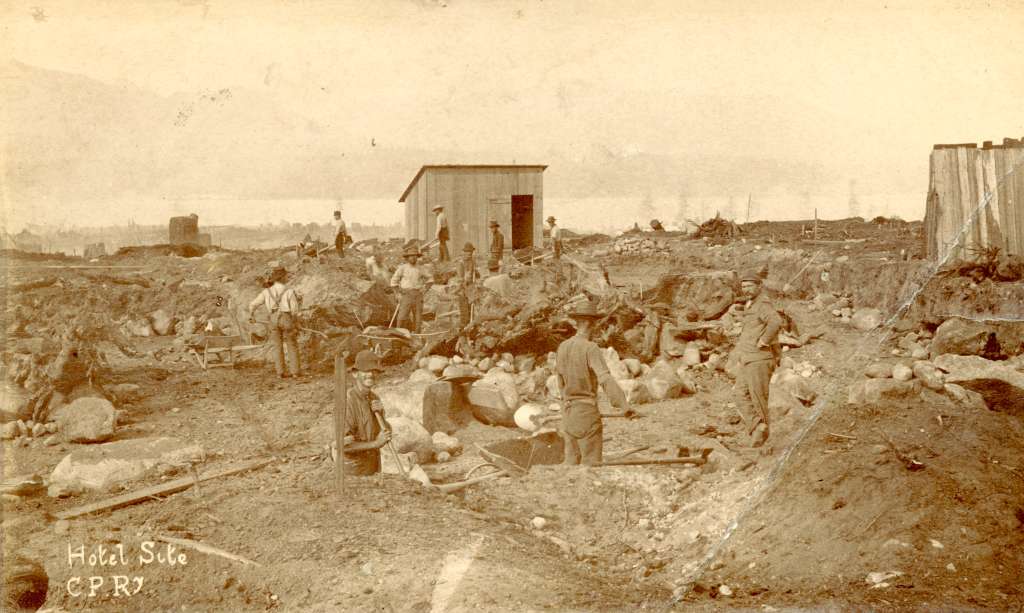
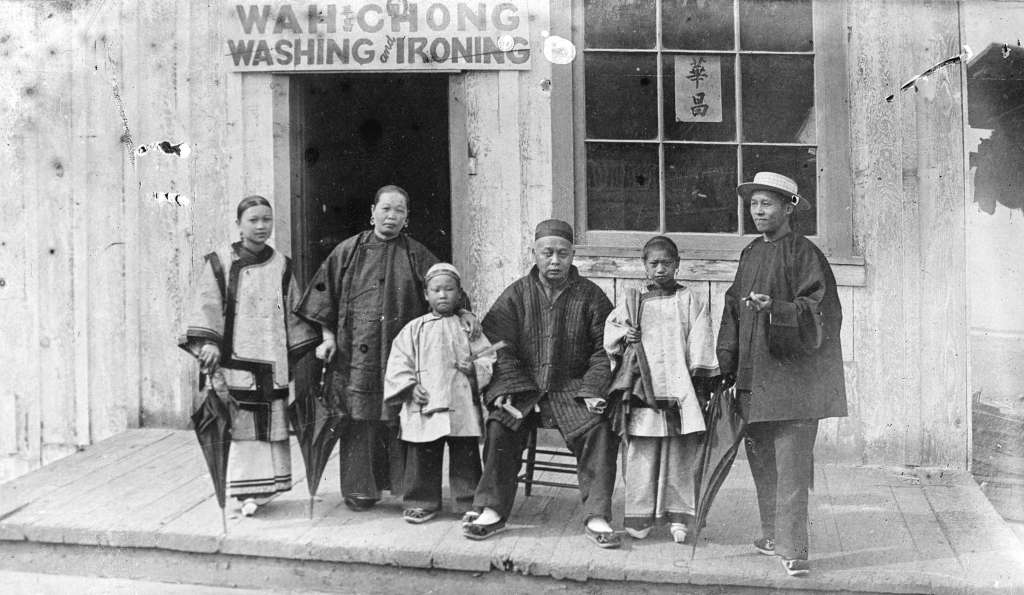


All of the above photographs are courtesy of the Vancouver Archives
On 13th June 1886 while CPR workers cleared the forests a fire began which quickly destroyed hundreds of buildings costing many lives.

“This drawing was started in 1931, in which there were [still] living in Vancouver at least fifty persons, men, women, children grown to adults, and Indians, who had either fled from the fire of 13 June 1886, seen it from a distance in all directions, or help to succor the distressed. Most of these were interviewed in 1931-1932, and their stories are recorded in the typescript volumes of ‘EARLY VANCOUVER’, J.S. Matthews, City Archives” source: Vancouver City Archive
In 1931 Welsh born Major James Matthews, himself a resident of Vancouver for over 30 years, set out to capture first hand accounts of the early days when Vancouver first came into existence. Those pioneer interviews provide our first insight into Old John, the Lamplighter.
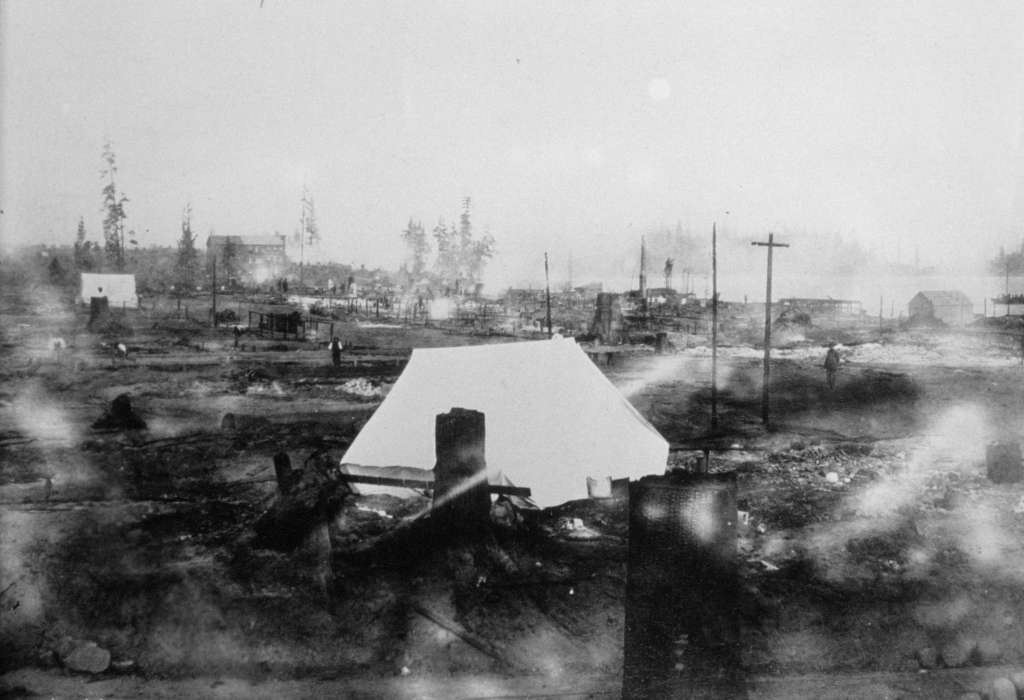
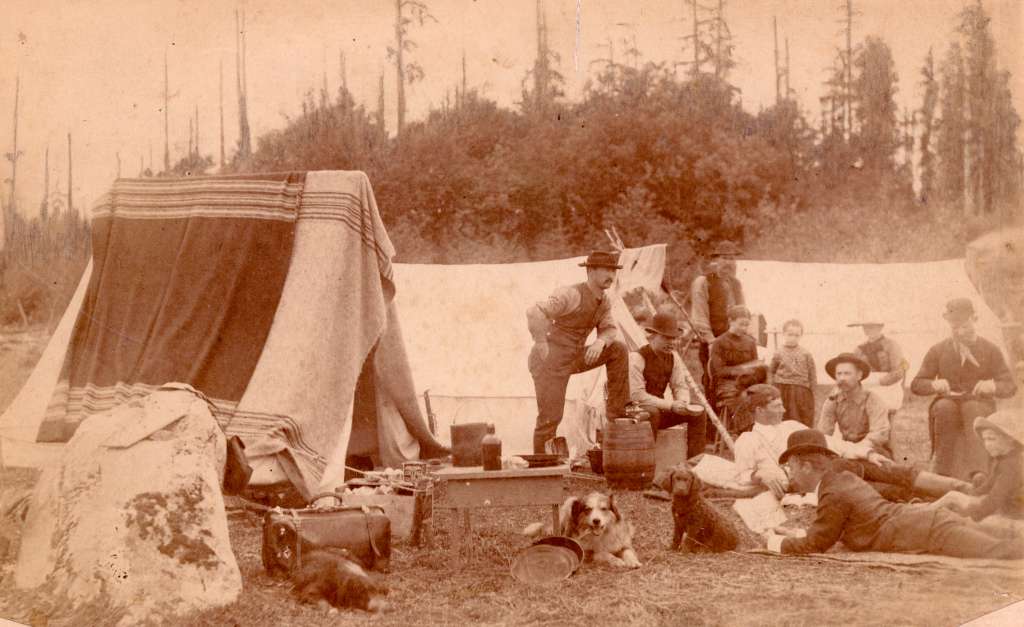
The above photographs are courtesy of the Vancouver Archives
Memories of Old John
… he [John Clough] was fond of the Flowing Bowl, he frequently got 30 days plus costs for being incapable … he was in so often he became a “trusty”, finally a gaoler … WH Gallagher, former Alderman, Special Constable night of the Great Fire
At the time of the fire John Clough was sojourning in the jail on account of having been generous in treating an Indian friend to firewater. When the fire gained uncontrollable headway the jail was forgotten and John did not propose to stay and be burned, so he let the other prisoners out [chained them to stakes] and … went out in the woods … after the fire … when he reported he had a pile of blankets … that would have kept the Turkish Army from getting cold feet. They came in mighty handy not only for prisoners … When asked how he came to obtain so many John’s laconic response was “oh I’m an old prospector”. John McLaren Asst. Chief of Police June 1886
Chunks of flaming wood as big as my leg were flying clear over us through the air and dropping into the town. … That night I slept in Spratt’s Ark (Oilery) and the wind blew through the floor boards, I was cold, very cold. Afterwards of course money was no use … I tried to get some blankets but there was none for me. Someone told me a good story about old John the jailer. After the fire he came in bearing loads of blankets on his shoulders. Some hinted that the old boy had ‘pinched’ them and hid them out in the woods, and when the fire came he brought them back again for the use of the distressed. Poor old John was real human. George Cary : contractor
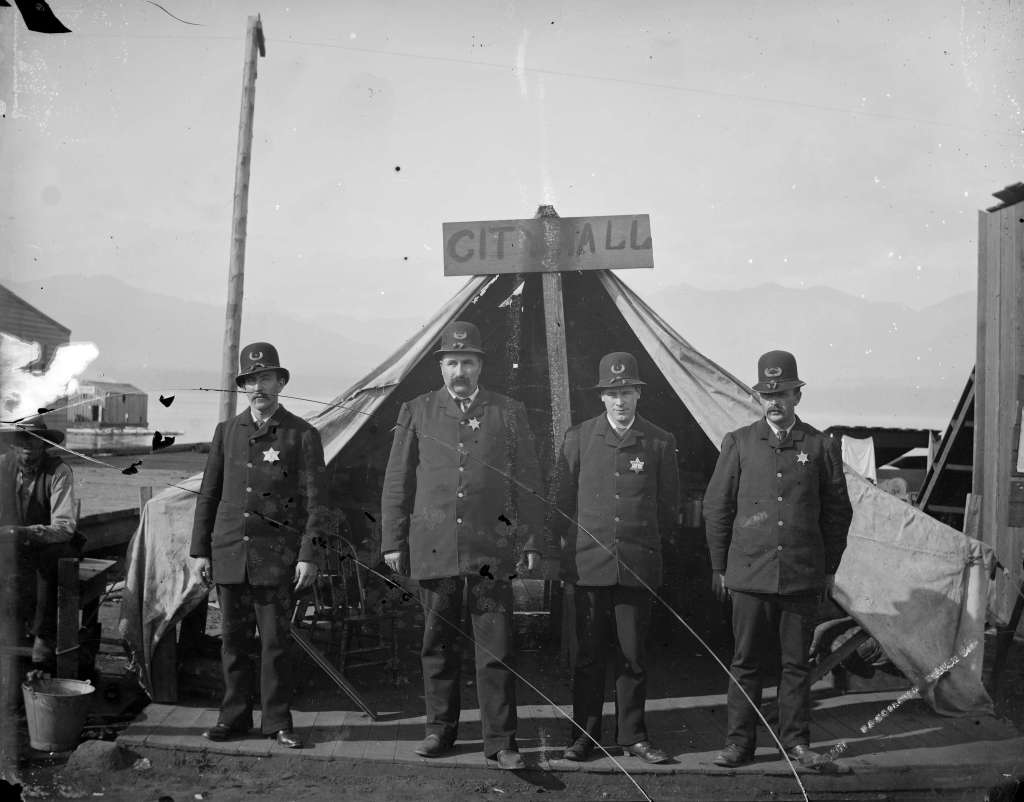
When asked why four policemen were needed in the township George Cary went on to explain that although a very small town, it was very lively , Water Street was built up with saloons and people were pouring in in droves.
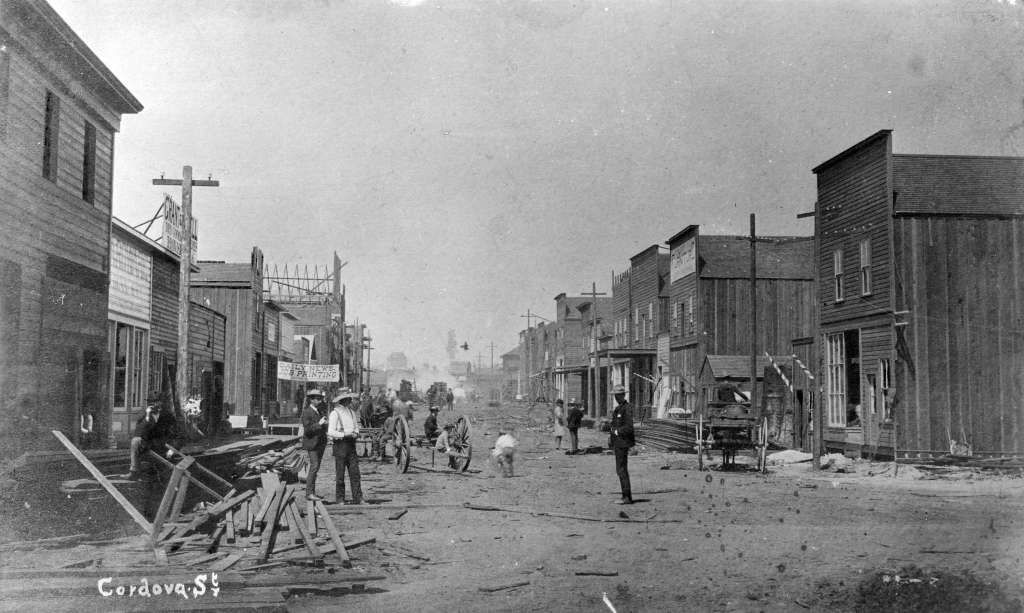
Christmas 1886: The late MA MacLean was mayor then and he thought the duty of the poilce force on that day was to ensure that everyone had his share of happiness rather than bother about making arrests. It was close to our duty that day to find anyone who was moping alone in a shack or a tent, and see that he got out and enjoyed himself. On that day in Vancouver crimes were not even thought of , much less committed. We did not have much of a jail to put anyone in anyway, and no-one would have been cruel enough to chain a man to a stump just because he had had a drink or two. There was a bit of a jail … [ in Old City Hall] on Powell Street, but what few prisoners were in it had a good time under the supervision of Mr John Clough. Every old timer remembers John, though he might not know who you were speaking of if you said Mister. John McLaren Asst. Chief of Police June 1886

The City Hall I built was about 25′ wide and 6′ long, a plain building with a verandah along the front on which John Clough used to sit most of the time. … I kept the City out of City Hall after it was finished … they wanted a lot of extras and kept delaying payment … I discovered they had not got the money so I would not let them in, only old John Clough the jailer I let him in. I met old John Clough with his one arm and said to him “if I let you in here you understand you have no authority … you are just looking after it for me” John says, in his quiet way, “alright I wont take possession or anything just stay in the building”. JW Sentell of Sentell Bros Vol. III

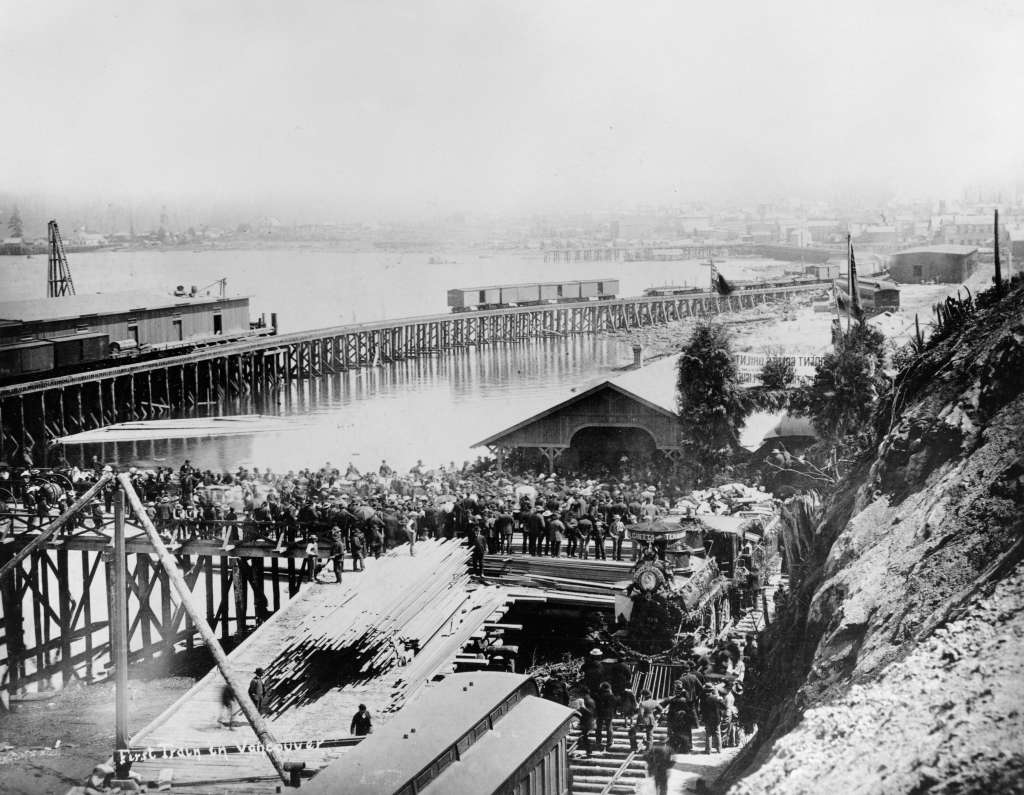
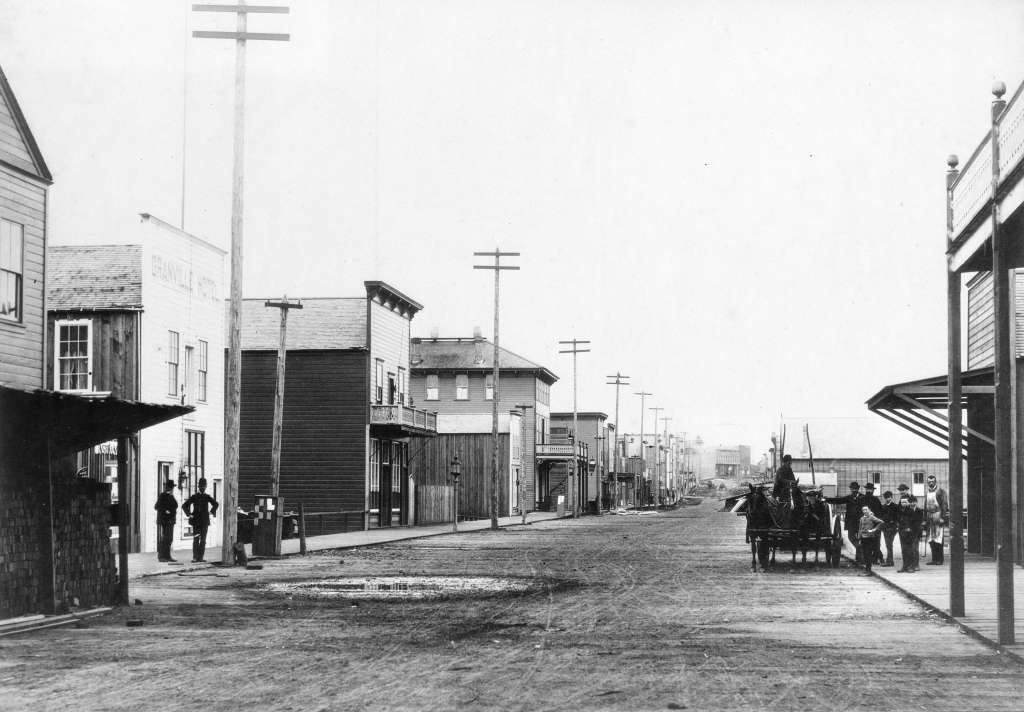
Above photos courtesy Vancouver Archive
The arrival of the first train drew huge crowds in May 1887, the City was well prepared for the event which heralded their great future. The expansion and progress of the City continued apace. Much of the clearing and hard labour for the city engineers was undertaken by the chain gang under the watchful eye of ” that historic character John Clough, the Lamplighter of Vancouver” cited by JS Matthews
James Matthews discovered the initial appointment of John Clough as lamplighter in February 1887, at a salary of $10 / month. On April 11th the position became permanent at $30/ month. He kept scores of coal oil lamps in an old back room at City Hall. Made of galvanised iron with a 7″ base and glass chimney the entire lamp was then placed in a glass shelter at the top of the lamp post. Despite his many, concurrent, roles for the city the label “Lamplighter” was his most renowned. Possibly the sight of this one armed man carrying his ladder to site the lamps was one not easily forgotten. The installation of electric lights began later that year but it is not clear when his duties ended.
One of the lamp posts can be seen below [you will have to zoom in] the balcony of the first building on the left in the photograph of the first Dominion Day Parade.
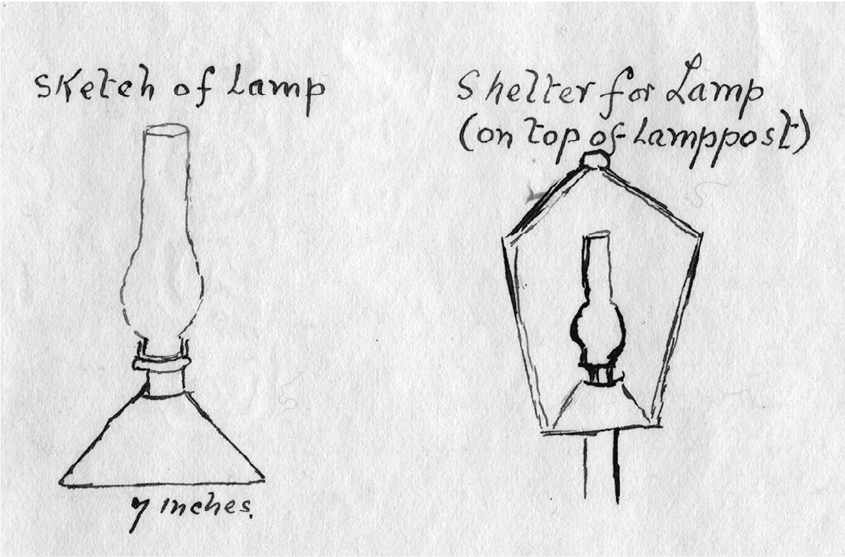
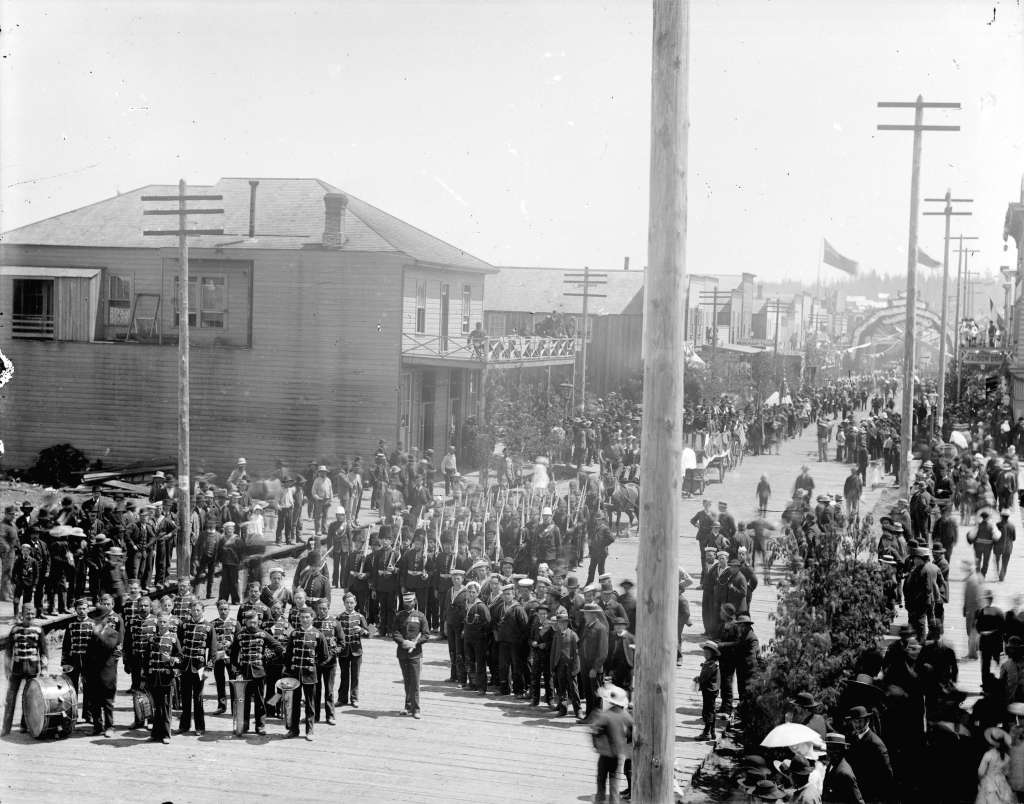
Courtesy Vancouver Archives
Victoria Daily British Colonist December 6th 1892 An organised attempt among the prisoners in the city lock up to break jail was averted yesterday. John Clough, the jailer, overheard one of the prisoners whisper ” Weeksiah nico coulee” to a klootchman. [ Native American Woman] Clough readily translated the words into English, “pretty soon I come” and notifying Chief McLaren, a search was made , when blanket ropes and other necessary hastily manufactured articles were found in readiness for a midnight flight. All the prisoners will be put in close confinement.

Victoria Daily British Colonist December 4th 1894 John Clough , assistant jailer, has [now] run two counterfeiters to earth. Moor, four years ago, and a chinamen at present under accusation. The chinaman counterfieter swore today he was not in the cabin when the plant was found. The owner of the shack swears that he rented the cabin to the prisoner two months ago. The money was made from pewter spoons and passed at 6 o’clock dusk. The work was very course but rang all right.

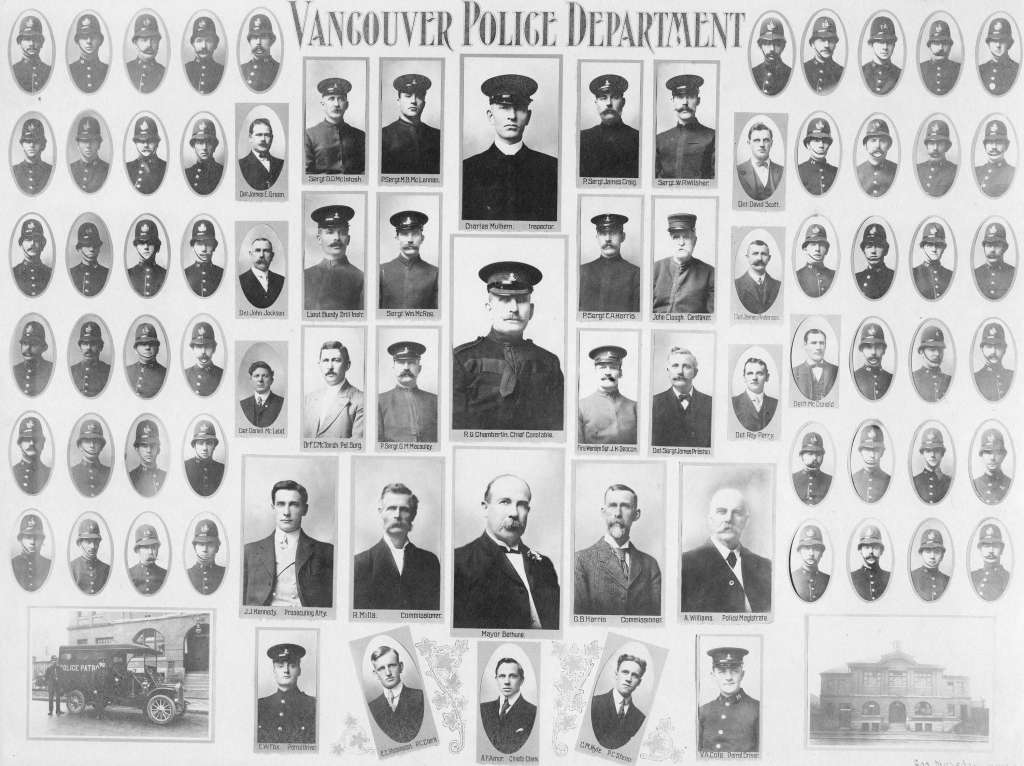
James Matthews also referenced the early days of the chain gang in Vancouver, in his role as jailer (John was appointed the role of dog catcher too) John Clough oversaw the work of these men.
The chain gang were slowly taken to the outskirts of the city on a cart every morning, equipped with picks and shovels, they appeared content. John Clough had a reputation for looking after the men, collecting old clothes for their comfort. The prisoners had been apprehended for minor offences such as being drunk and disorderly, they were comprised of loggers and sailors sentenced to hard labour for up to a fortnight. They wore two ankle cuffs connected to a waist belt by a long chain. John Clough had previously been a member of the chain gang.
In later years John’s nephew would tell JS Matthews
“My uncle was a character, a great character … he never had any money for the reason that, if he could stop it – by furnishing the money for her fine – he would never allow a woman to be locked up, and, as men were often discharged from jail in a penniless state, he often “staked them.” Edward Clough cited by JS Matthews Vol I
An intriguing past – The road to Vancouver
John’s nephew was among those interviewed by James Matthews in 1931 his understanding of the key events in John’s life prior to Vancouver were as follows.
John was drawn to California by the discovery of Gold at Sutters Creek in 1849. He sailed in to New York and was subsequently found work with a cattle drive across the plains. He found success at the Sacramento Diggings and booked passage back to England from San Francisco. Celebrations with fellow miners detained John and he lost his passage , however the ship caught fire at sea with many losing their lives. A situation which subsequently led to John’s declaration that “you cannot tell me that drink ever did me any harm”
Following his time in California, John moved to the diggings around Cariboo but he had no success there, I do not know what happened for a couple of years. He later became a forman for Onderdonk a contractor for California Pacific Railways in parts of British Columbia. It was in this role that John Clough lost his arm, having returned to examine a blast that had not exploded. A summary of Edward Clough’s conversation with JS Matthews. Vancouver Archives
Edward’s tales of his uncle provided a guide in the search for John Clough’s experiences prior to Vancouver. How many of John’s stories could really be substantiated ?
Amazingly, even in the Wild West John Clough was captured on paper. The time line that follows has been substantiated by official records.
1831 to March 1851
John was part of a large family at Willoughby, baptised in 1831, his father William was a Chelsea Pensioner and times were hard. Local newspapers reported family clashes with authority in the form of poaching and drunkeness. John’s sister Charlotte remained single frequently residing with other family members, she would go on to lose three out of her four children. When John finally returned home Charlotte and her son Fred were close neighbours on Finsbury St. In March 1851 20 year old John was recorded as a farm servant for Christopher Ayscough at Bratoft but just a few months later he was among those that followed the glittering dream of riches promised by the Californian Gold Rush and widely reported in Lincolnshire as elsewhere.
June 1851:
John sailed into New York on the Seringapatam from Hull arriving on June 18th 1851. The next step was to get to San Francisco, and then on to the Sacramento diggings. Sea passage was the quickest route but when funds did not allow it was a case of crossing by land. Tens of thousands were following the trails across the plains but it remained the most dangerous way to cross. The following extract is from a letter reproduced in The Stamford Mercury describing the overland journey.
A Lincolnshire Man in California … The writer emigrated about three years ago to Wisconsin … but, hearing of the wonderful discoveries in California, he proceeded with a company of gold seekers to the distant banks of the Sacramento. The perilous and heart-sickening nature of his over-land journey is described below:-
The writer began his journey in Rochester, New York in April 1849
Dec 28, 1849.—“ Yuba River, California, we got into the valley on the 16th October, we have had a very long journey. We had two deserts to cross . On the first desert, the stench from dead cattle was horrible, and I presume by this time that the the carcases of exhausted animals would touch each other for forty miles, if they were laid in a line: they died from want of grass and water. … Our company had a good team, having traded for fresh cattle at the Salt Lake Valley so we got safely through. Many adventurers lost all their cattle and wagons too. —Until now we have not slept under any roof, but many times soundly on the mountains, guarding our cattle from the Indians, with packs of wolves howling around us. We got so used to these ferocious beasts that we did not mind them. We had to take our cattle several miles from camp to get grass and were sometimes beset by Indians; on one occasion they shot three arrows into one of our oxen. Some companies lost all of their teams. It was intensely cold when we were at the greatest altitude. Some people began to look rather blue before we crossed the “big ridge” for in a very short space of time the snow fell about four feet. … As to gold there appears to be an inexhaustible supply; but the getting of it is not so easy as many suppose. Stamford Mercury May 1850
John’s route from New York cannot be proved but he would not have had the funds for sea passage so the overland trail West from Missouri, via Buffalo, is likely. Many left St Louis , purchased waggons and supplies in Independence and followed the Oregan Trail taking the California Branch to Sacramento. In the early years of the gold rush Californian cattle, bred for their hides, could not feed the influx of people and, despite widespread tales about cattle drives from Texas, in the 1850s many drove cattle from Missouri too. The emigrants left in the Spring in the hope of avoiding the worst of the weather. It is certainly plausible that John Clough undertook this route, it matches his nephew’s version and was the route of choice for those in his situation.

Diaries and journals of the era provide first hand descriptions of the difficulties encountered by those on the trail. Lack of water, spoiled food, disease, traversing rivers, adverse weather and avoiding confrontation with some Native Americans – trading with others – are threads throughout all of these publications. The above letter is reasonably representative although, according to the weather during the season, many of the abandoned cattle would form wild herds. When large numbers of cattle were being driven they must also be rested and watered and dust was a huge issue severely limiting vision. River crossings must be suitable for them to be driven or pushed to swim across. Many cattle and men were lost along the trail, the latter buried some cattle eaten, or in the case of the stranded Donner Party of 1846 some of the pioneers may have resorted to cannibalism.
31st July 1860 Sacramento Diggings
To date no evidence to connect John Clough to a specific date or party as he crossed North America has come to light. On 31st July 1860 John Clough is recorded at Township 4, Amador County. Sutter Creek, Post Office. He was mining at the heart of the Sacramento diggings, surrounded by like minded men from Scotland, America, Canada and China. John was boarding in a small hotel owned by the Marks family, there were 14 other boarders including a carpenter, a butcher, a shoemaker and a school teacher. The remainder were miners and teamsters.

John had reputedly related to his family that he had done well at Sutter Creek and booked passage home from San Francisco. He had been diverted from this course, due to drinking with other miners, and lost his passage, however the ship caught fire at sea and many lives were lost. This story always closed with the declaration ” you can’t tell me that drink ever did me any harm”.
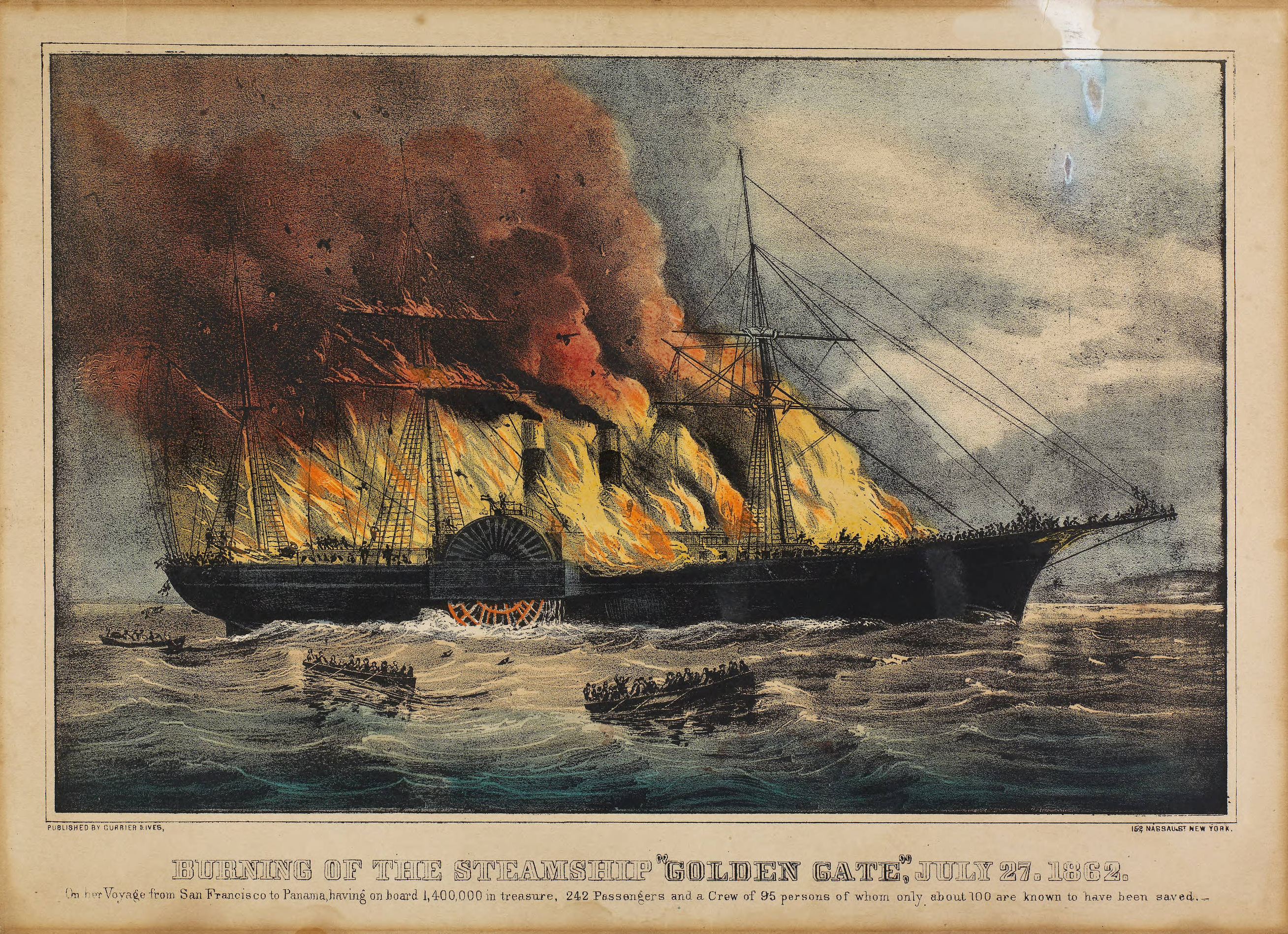
The SS Golden Gate caught fire at sea in July 1862, it sank with many prospectors’ gold but it is not a connection that has been proven.
1870 to 1881 California to Britsh Columbia
Bwtween 1870 and 1880 John Clough appears to have followed the gold, initially remaining in California. In 1870 he is listed at Township 2, Tuolumne, California. Recorded as a teamster, living among miners from all nations, including an Irish family with seven children and 10 chinese men.


Source : Lawrence and Houseworth : Library of Congress 1866
John’s work as a teamster would involve moving heavy loads driving a team of animals, in itself this suggests a larger mining concern and the available photos of mining in Tuolumne at this time show the prevalence of placer mining.
The 1881 census captures John Clough in Victoria City, – Yates Street Ward -Vancouver Island, British Columbia, this time recorded as a farm labourer. There is not ahead of household recorded. Not to be confused with Vancouver City which was later incorporated on adjacent mainland.
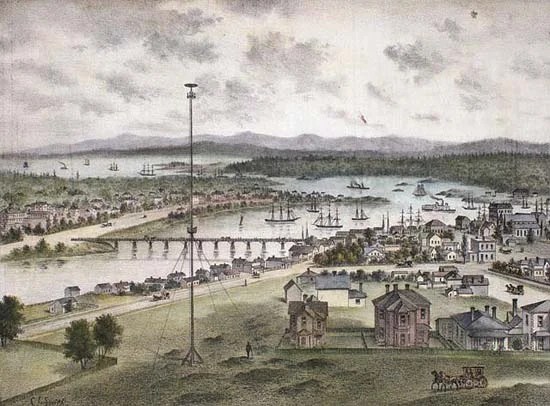
Victoria City was the haunt of many Cariboo miners and close to the Fraser River, site of another Gold Rush. In 1984 a correspondent from Canada wrote to the Lincolnshire Life about John Clough, providing additional information that he had mined along the Fraser River. The stories of John having mined at Cariboo and along the Fraser River cannot be substantiated but in his own words he was an “old prospector” and he was certainly in the right areas. His nephew had indicated that he had stopped mining following disappointments at Cariboo and this may be the reason behind him living in Victoria City on Vancouver Island and getting casual work as a farm labourer. The label seems at odds given the details of the rest of the household – possibly a boarding house of sorts but not a family environment – another 21 men of various nationalities and work as diverse as hotel clerks, sailors, miners and cooks. A fish canner and an accountant head up the list but there is no indication of them heading the household.
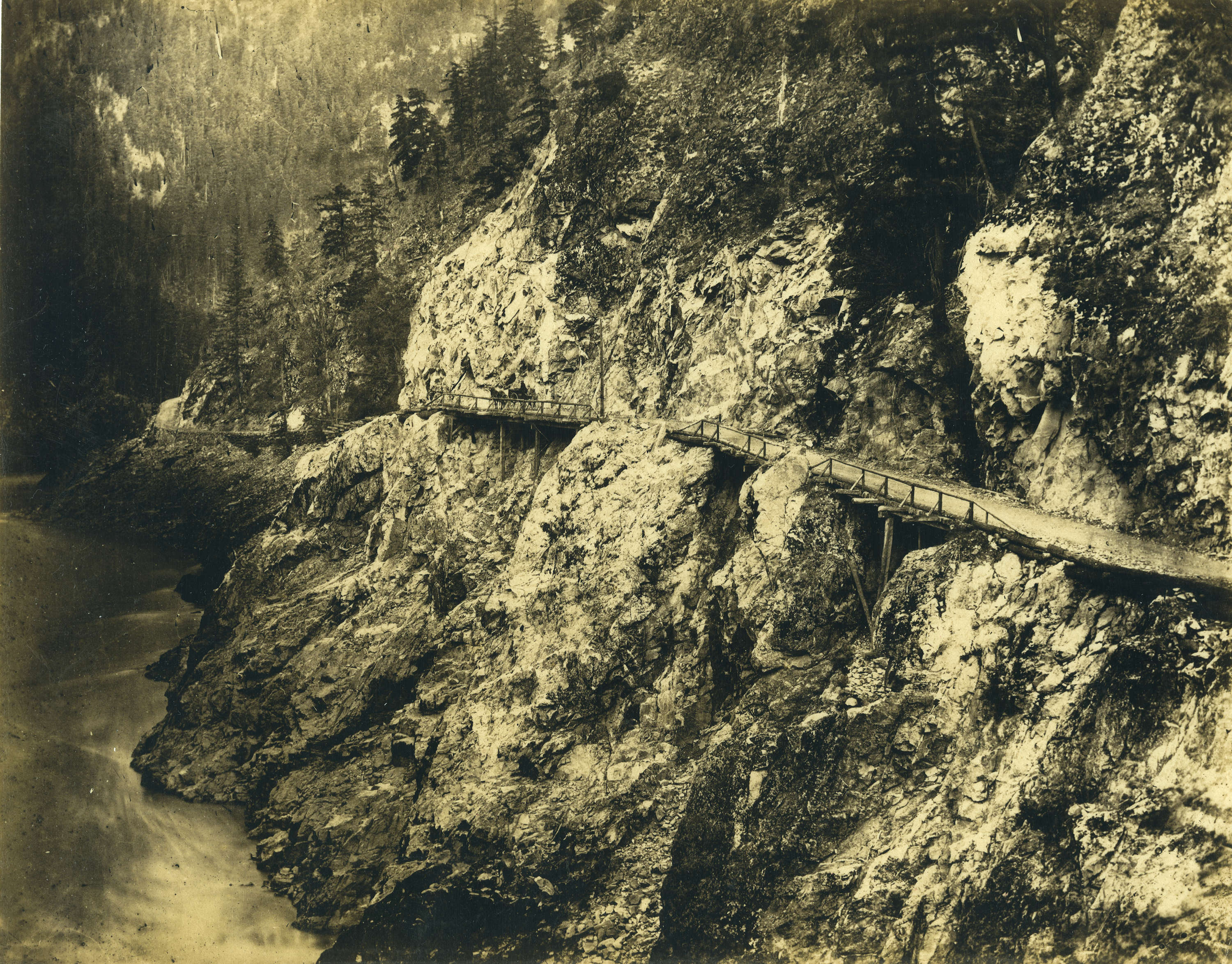

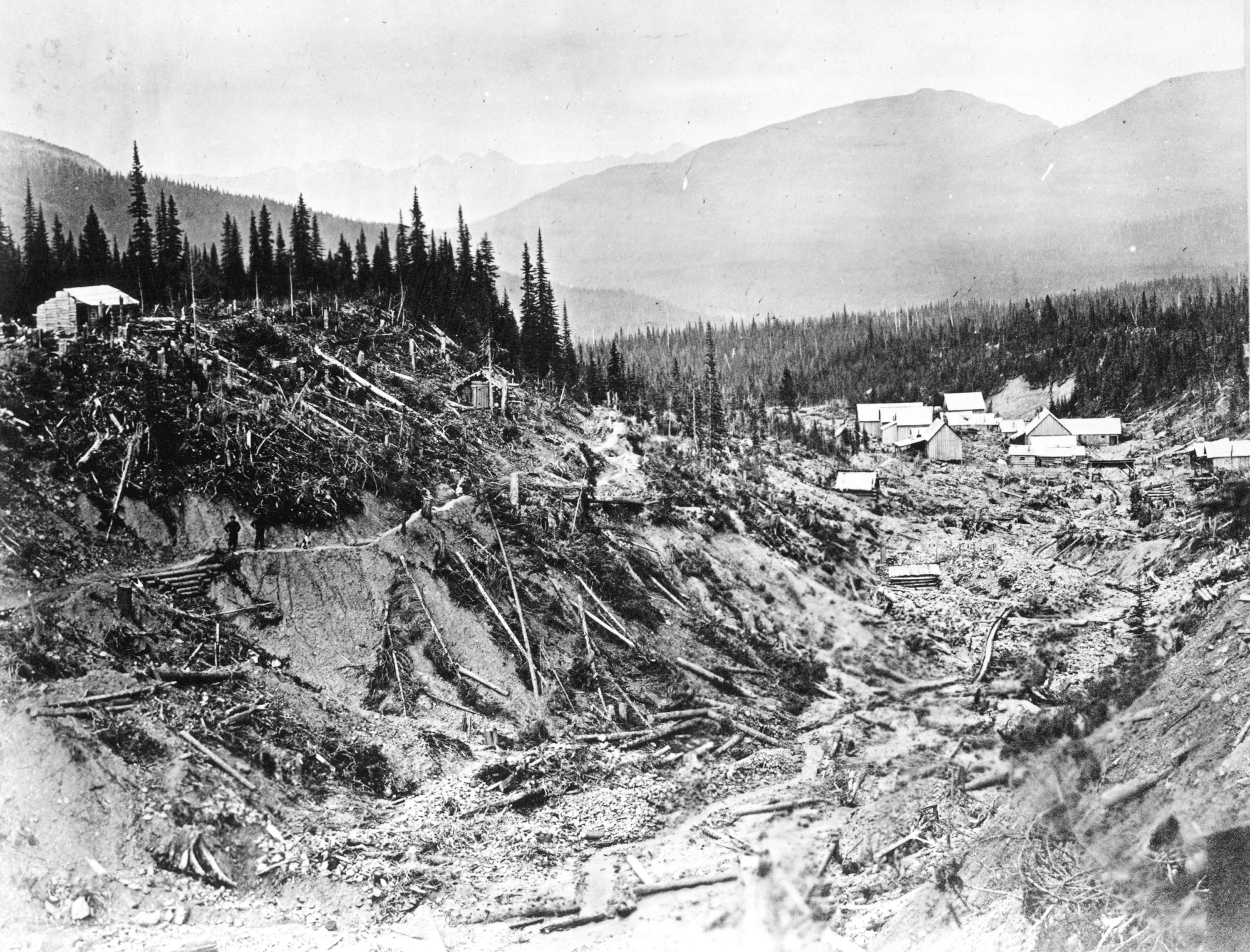


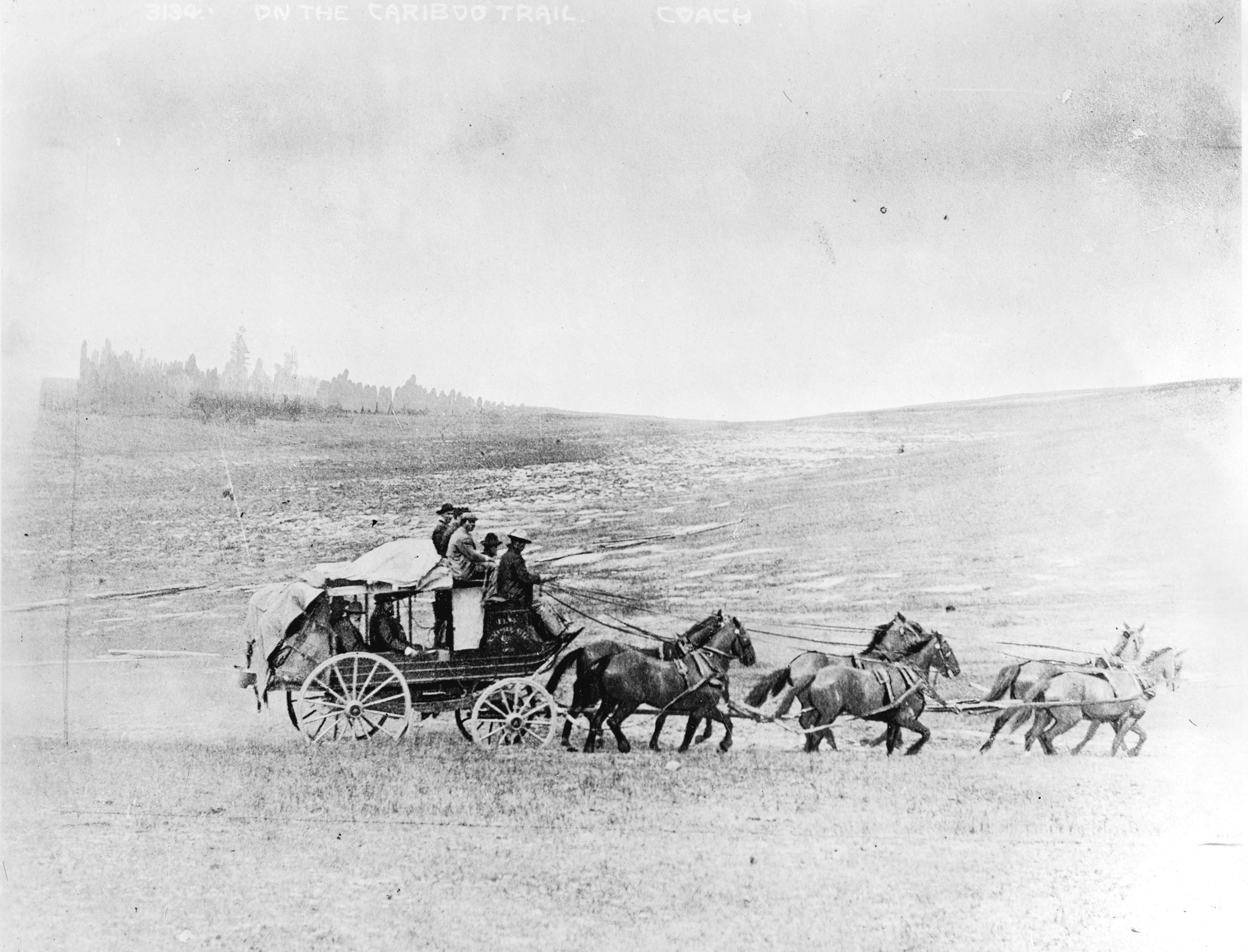
Above photos courtesy Vancouver Archives
A series of newspaper articles shed a little more light on John’s circumstances in 1the 1880s and he seems to have fallen on hard times. This fits with Edward’s story that having failed at Cariboo John cut loose for a couple of years.
Victoria Daily British Colonist July 11th 1880 : Municipal Police Court J Clough, charged with supplying whiskey to Indians, was remanded until Wednesday next. Charley, an Indian charged with being in possession of an intoxicant , was sentenced to a month’s hard labour.
Victoria Daily British Colonist July 15th 1880 : Municipal Police Court J Clough was convicted of supplying intoxicating liquor to Indians and ordered to enter into his own recognizance in the sum of $50. Ah Wah , a chinaman convicted of a similar offence , was sentenced to three months imprisonment with hard labour and fined $50, in default of payment three months additional imprisonment.
Victoria Daily British Colonist March 4th 1881 : Municipal Police Court John Clough was charged by a Chinaman named Ah Singh with stealing an old broken stove. The prosecutor stated that he saw the prisoner with the stove which he threw down. Witness then got a police officer who took prisoner into custody. Wm. Griffiths, called for the defence, did not know anything about the prisoner or the stove stealing. Supt. O’Conner stated that the prisoner had been convicted of selling whiskey to Indians and was a noted thief. Sentenced to three months imprisonment with hard labour. [ Ah Singh is recorded adjacent to John Clough on the census]
John Clough was now aged 50, assuming he had turned his back on mining, he would have needed steady work when he had finished his sentence. The newspapers were full of the Canadian Pacific Railway and they were desperate for labour. Contractor Andrew Onderdonk imported chinese workers in their thousands to keep the project going. In 1881, 1882 and 1883 chinese labourers were contracted directly from Asia. To appease the provincial government in Victoria, and the antagonistic white population, Onderdonk agreed to give white men preference, John Clough was hired.
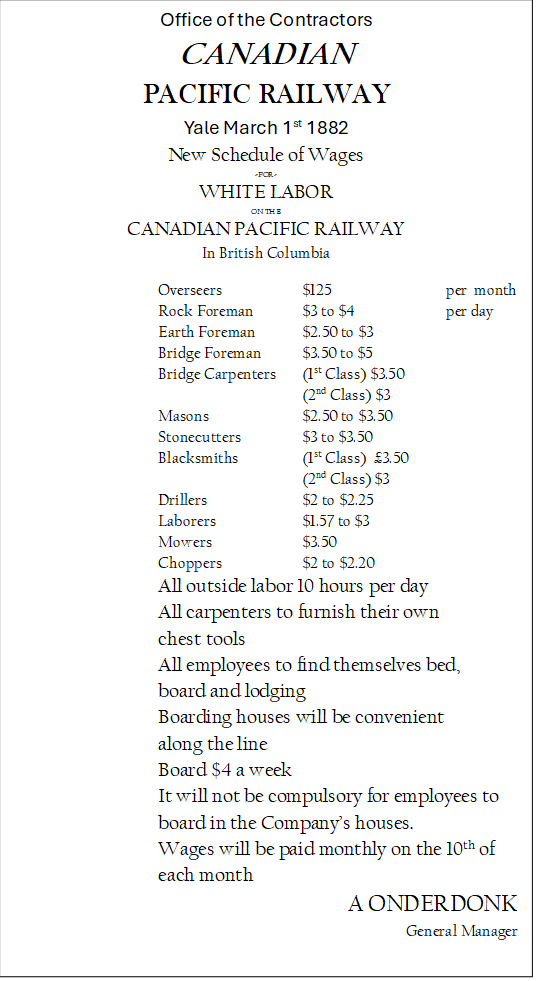
Canadian Pacific Railway at Yale
The contract to complete various sections of the Canadian Pacific Railway had been awarded to Andrew Onderdonk who based his operations in Yale. Following his arrival early in 1880 construction began. Engine and repair shops were built, along with some facilities for workers although many would live in camps. A sawmill was constructed at Emory just South of Yale. A nitroglycerine storage building and a dynamite powder factory were also completed.
The Fraser Canyon Gold Rush (1858 – 1927) had centred around the Hope and Yale, within months of the news reaching San Francisco tens of thousands had descended upon Victoria from California.


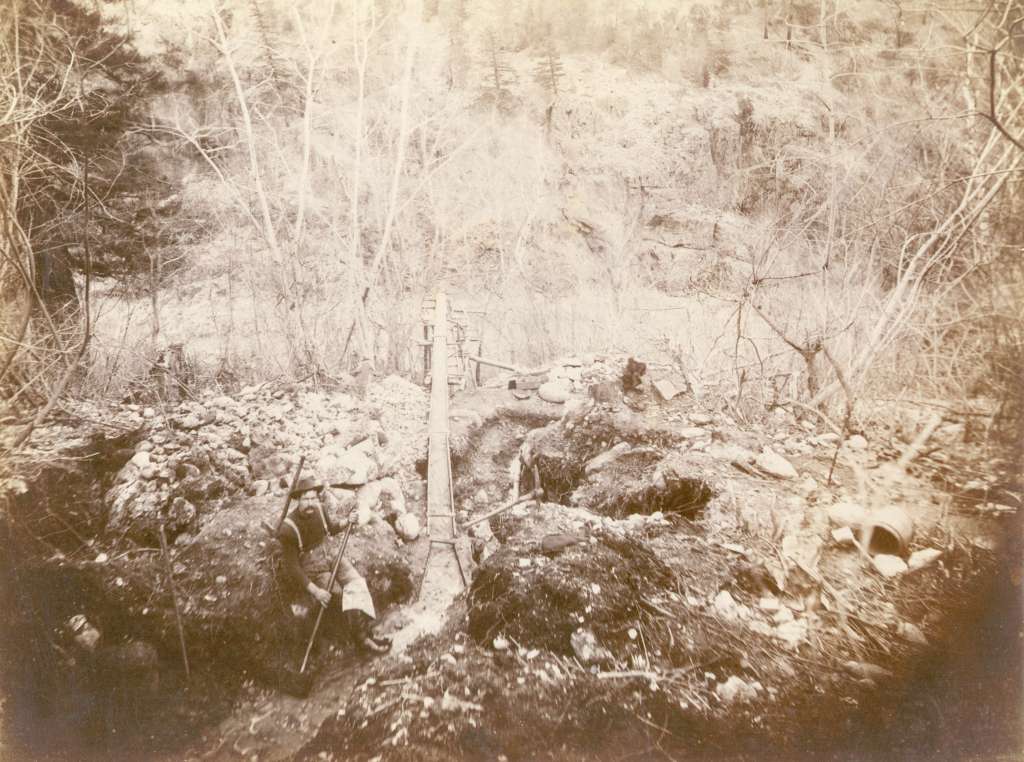
Photos courtesy Vancouver Archives
During his years at Cariboo and panning along the Fraser River John Clough would have been familiar with Yale.
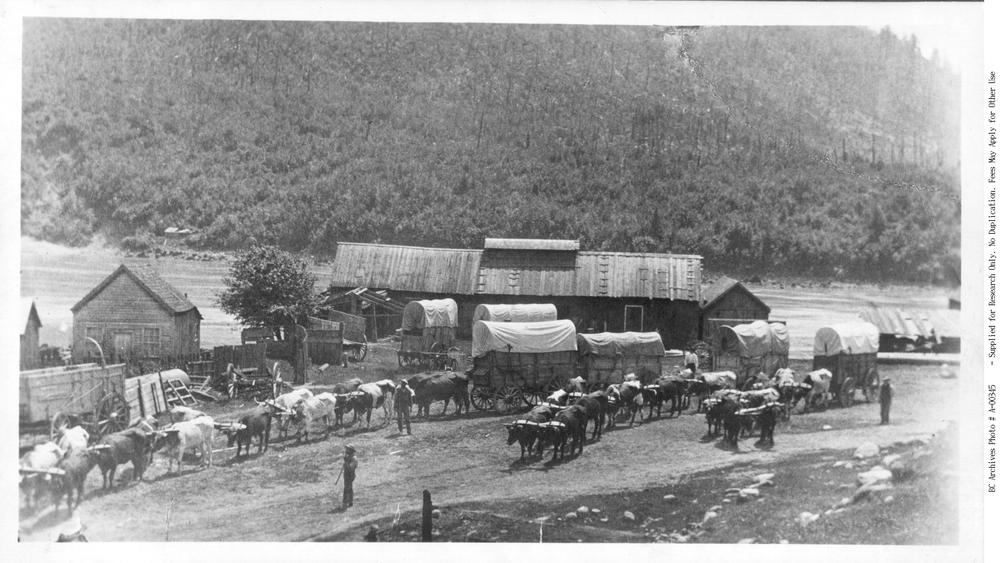
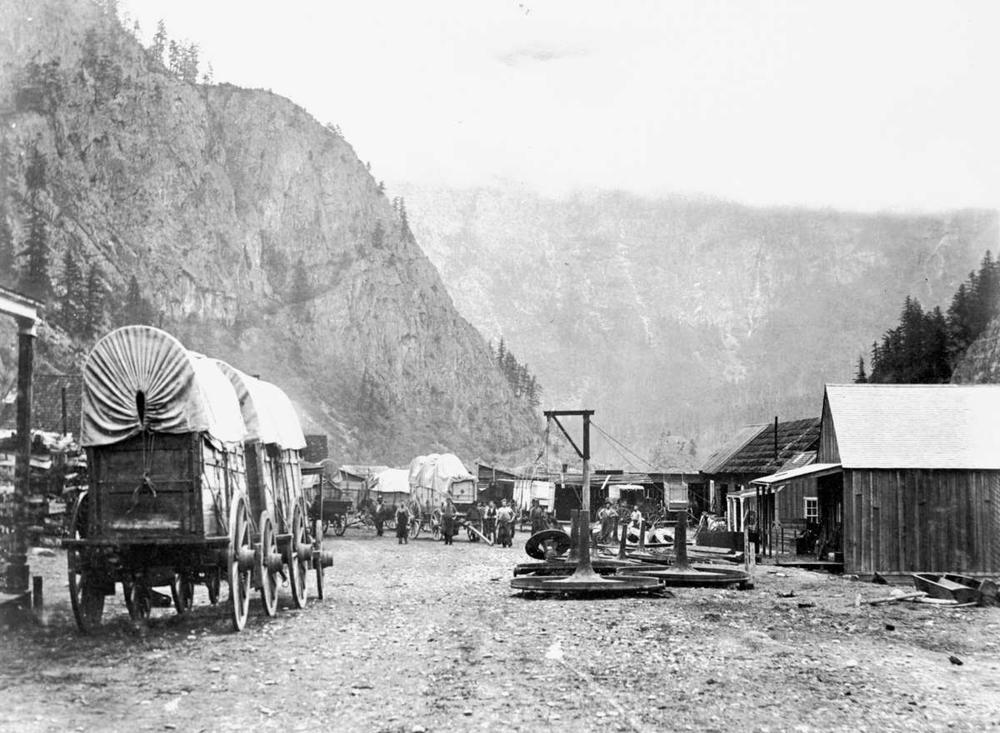


Extract from Canadian West Magazine In the early years during the Fraser River and the Cariboo gold rushes [Yale] had been a real Wild West town with shootings etc. Now once again it was a rip roaring boom town. With hundreds of, even a thousand, men on pay day having nothing better to do but drink, gamble or make whatever ruckus they could raise. [ A visitor on payday wrote] … “The one long business street fronting the river presented a scene and sounds, at once animated and grotesque – bizarre and risque. The shell like shacks of saloons whereof every third building was nearly one, fairly bulked and bulged like Brobdingnazian [giant] wasps’ nest, whose inmates, in a continual state of flux, ever and anon hurled in and out in twos and threes of tangled, wrangling masses. Painted and bedizened women lent a garish color to the scene. On the hot dusty roadside, or around timbers, rails and other construction debris, men in advanced stages of intoxication rolled and fought or snored in bestial oblivion” Steel Rails and Canyon Walls . Leigh Gordon
Given his love of drink and life as a prospector John Clough may have felt very at home in this environment. White workers handled the explosives used to blast through the rocks alongside the Fraser River.
AG Ferguson was a tunneller who made his fortune working for the CPR before moving into Vancouver in 1885. Ferguson was based in Hope at this time, Ferguson’s Camp referred to his workers base. Wong Hau Hon a worker for CPR who arrived in 1882 recalled his experiences of the time.
We were ordered to Hope. The work there was very dangerous. On one occasion, a huge rock had to be removed by blasting. More than three hundred barrels of explosives were used. … Another incident occurred west of Yale. Twenty dynamite charges were ignited to blast a rock cave, but only eighteen went off. The white foreman, thinking all the dynamite went off, ordered the Chinese workers to enter the cave to resume work. Just at that moment, the last two charges exploded. Chinese bodies flew from the cave as if shot from a cannon. Blood and flesh were mixed in a horrible mess. About ten or twenty workers were killed.Source: Joe Huang and Sharon Quan Wong, eds., Chinese Americans: Realities and Myths Anthology (San Francisco: The Association of Chinese Teachers, 1997), 14-15. Cited by LabourHeritageCentre.CA
The Coquihalla River flows into the Fraser River at Hope.
They call the rolling hills opposite the mouth of the Coquihalla River “Lexwpopeleqwith’aim” – it means “always screech owls” but the word took on a dual meaning as a reference to the ghosts of Chinese workers who are said to haunt the area where many were killed during a blasting accident. A forgotten history: tracing the ties between B.C.’s First Nations and Chinese workers: Justine Hunter Hope B.C Globe and Mail 2015
The exact incident involving John Clough is not clear, there were many such incidents.
Victoria Daily British Colonist October 8th 1882 : Yale 28th Sept. John Clough had his arm shattered while [standing in for] his foreman at Ferguson’s Camp, near Hope. He is now in the Yale hospital, very weak after the amputation of his arm last Tuesday.
The railway company operated an accident hospital at Yale – for the White workers who contributed towards it from their wages – accidents along the line were frequent and many publications refer to the concerns over the mishandling of the blasting powder. The chinese workers were provided with some medical care in their own camps but there were very badly treated.
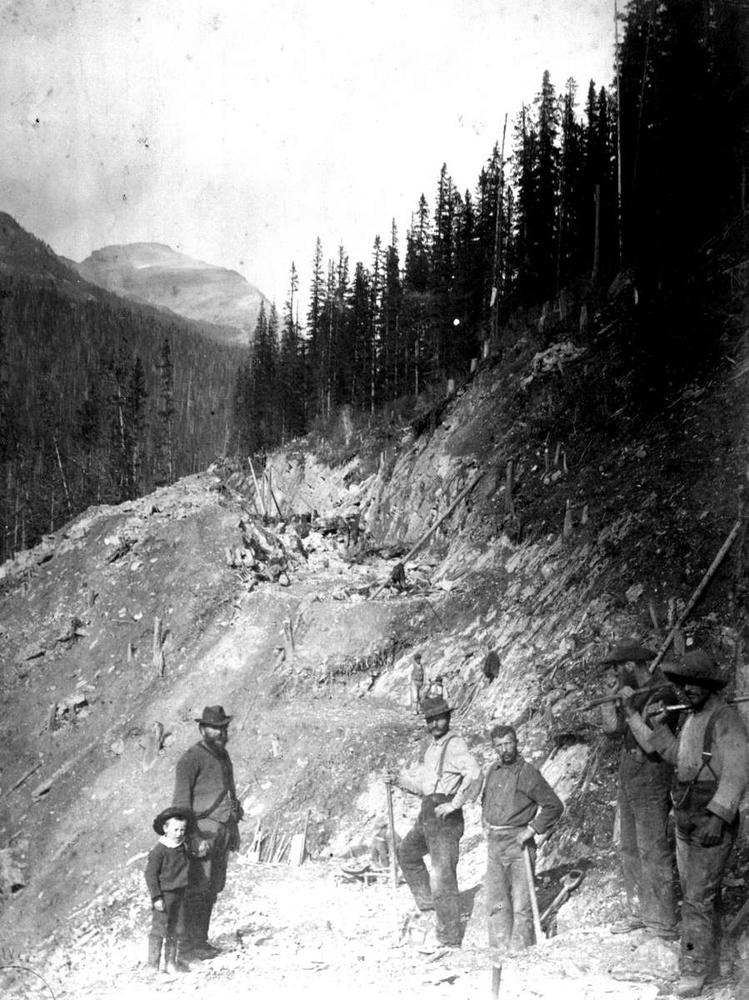
BC Archives g-01151_141

BC Archive a-00856_141


BC Archive i-30866_141
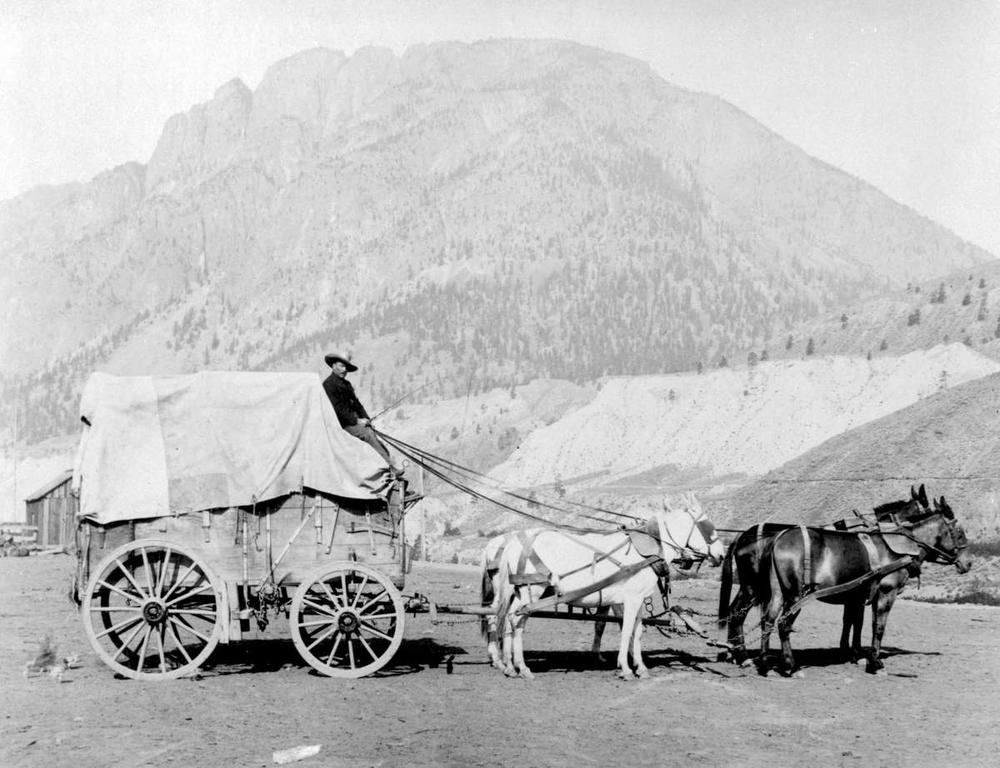
BC Archive i-30865_141
The above gallery contains images from John Clough’s time as a CPR worker
1884 to 1886 Canadian Pacific Railway to Vancouver

We know that John Clough was in Vancouver before the fire of June 1886. Having lost his arm his options would have been extremely limited and his life between the hospital and Granville (Vancouver) is unknown. The Winter of 1882 / 83 was particularly harsh. The decision to create the terminus of the CPR in Vancouver was controversial and led to a boom in land around the area, upsetting the many speculators who had already purchased parcels of land at Port Moody where the Company had originally advertised the terminus. It would have been a good place to scratch a living and John Clough’s reputation among the pioneers shows that he was considered kind and they accomodated him.
That is the story of John Clough, he returned to England in the Summer of 1911. What experiences that man had, it would have been nice to talk him I bet he could tell a good story, over a drink or two.

By RestfulC401 WinterforceMedia
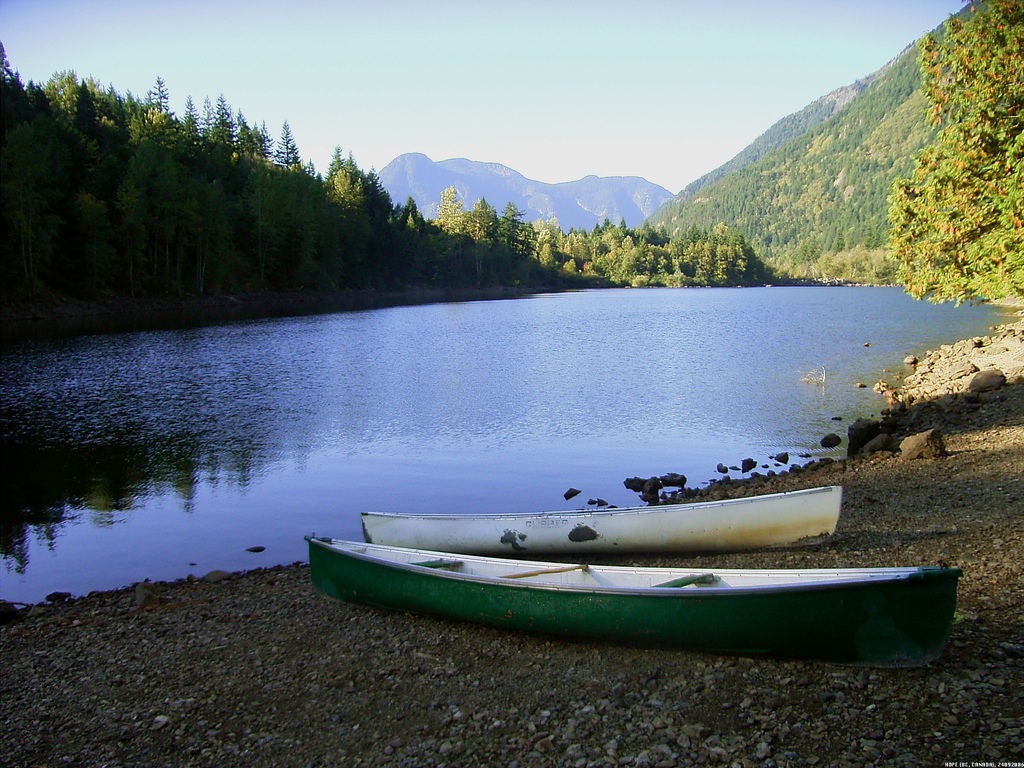
By Jeff W Brooktree
 About Alford