

The Letter
Tuesday October 24th 1843: In that moment he was resolved, there was nothing for it but to write to his Lordship once more. He had held a respected position in Alford for many years did all of that count for nothing? How had it come to this? John Nicholson would not accept his situation, he knew what lay down that path, he began to write a second letter.

Once more I must humbly beg of your Lordship to pardon the liberty I have taken in addressing another letter … I had my poor distressed wife to see me last Sunday, she informs me that my dear children as well as herself are nearly [destroyed] at my miserable situation and absence. She also informs me there is plenty of employment for me in Alford, the neighbourhood only waits for my return [for me] to be immediately placed. That is to attend on Gents Parties so that your Lordship will perceive that I will not return as an encumberance upon my family … I held the situation of Postmaster for 18 years during which time, up to the present unpleasant affair no charge of dishonesty has ever been made against me although large sums of money have passed through my hands to several influential Gents. … I should also feel grateful would your Lordship prevail of the Earl of Yarboro to speak or write on my behalf as his Lordship will recollect my conduct during the 8 years I had the honour to live in his Lordships family as the Under Butler …
A Background in Service
In June 1825 John Nicholson and his wife Eleanor celebrated the baptism of their first son, Robert, in Wrawby near Brigg. John had been the landlord of the Black Bull on Wrawby St. in Brigg for at least three years. He regularly appeared among the members of the Brigg Association for the Prosecution of Felons (1).The family lived within a few miles of Brocklesby Hall, the seat of the Barons of Yarborough, and Manby Hall, the home of the heir.

Several paintings just show the view across the lake, but the full extent can be glimpsed here.
The architects drawing below shows the ambitious plans of this wealthy family.
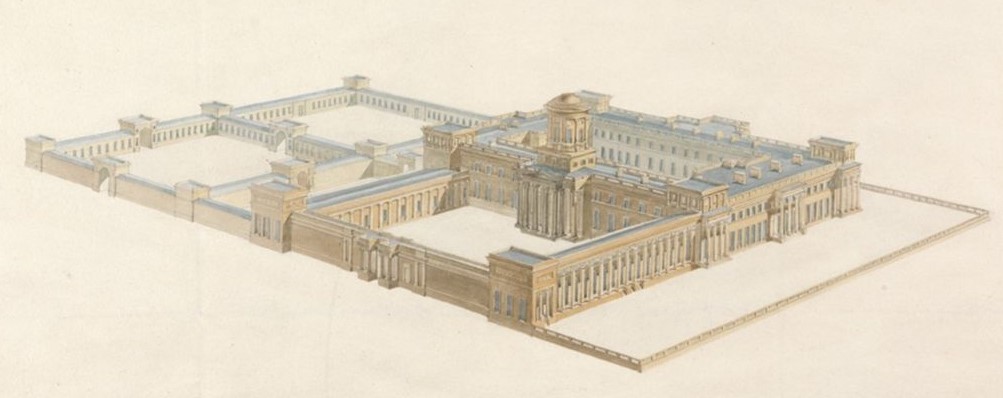
John Nicholson’s service for Lord Yarborough is likely to have been at Brocklesby Hall(2). The role of Under Butler was not a small undertaking and required years of work to achieve within the hierarchy of servants. A promising youngster, often known from an estate family, would begin at an early age as a Hall Boy, progressing to a Footman, before becoming First Footman then Under-Butler. The role required the full confidence of the Butler that his work could be competently covered in his absence.
The Butler was said to rule the household, more so if a Steward was not employed. Discretion, impeccable manners and dress were required to serve meals and drinks to the aristocracy. The Brocklesby Hunt was renowned and undoubtedly a good foundation for Nicholson’s skills as a host of shooting and hunting parties, Gents Parties as he terms them in his letter. The presentation of the dining room along with care of the wine cellar and the security of the silver plate were particular responsibilities of the Butler. The plate safe usually being located close to or off of the Butler’s room(s).
Consideration of John Nicholson’s past makes a move into the hospitality trade understandable. It was far from unusual for “retired” butlers to put their hosting skills to use in the hotel business, William Claridge of the luxury London Hotel made the transition from Butler to hotel owner. Census records reveal that both John and Eleanor were born outside of Lincolnshire, another document records John Nicholson’s birthplace as “Castle Howard”, if accurate he may have been born on that Estate and entered service there. The exact details are unknown but Mr Nicholson certainly appears to have had a good knowledge of how the gentry lived, how they should be addressed, suitable food and drink and, most importantly, the correct way to serve it.

The Alford Postmaster
1822 had brought important changes to the Alford mail connections, public notices announced the new Louth To London Royal Mail coach route.

In November 1825 local newspapers reported the death of Mrs Mary Young, widow, landlady of the Windmill Inn and Postmistress. The Nicholson family moved to Alford.
John Nicholson’s official roles in Alford first appear in print in 1826 when Quarter Session records list him as the licensee of the Windmill Inn, he also served as the postmaster, driving the mail himself between the Windmill Inn and the New Inn at Ulceby Cross where he met the Louth / London Mail Coaches.

John and Eleanor’s family continued to grow with the birth of Henry followed by Ellen Mary (c.1830) and Hannah Elizabeth (c.1832) the Excise office remained at the Windmill, and local papers announced the many and various official meetings held by local gentlemen at the House of John Nicholson, the Windmill.

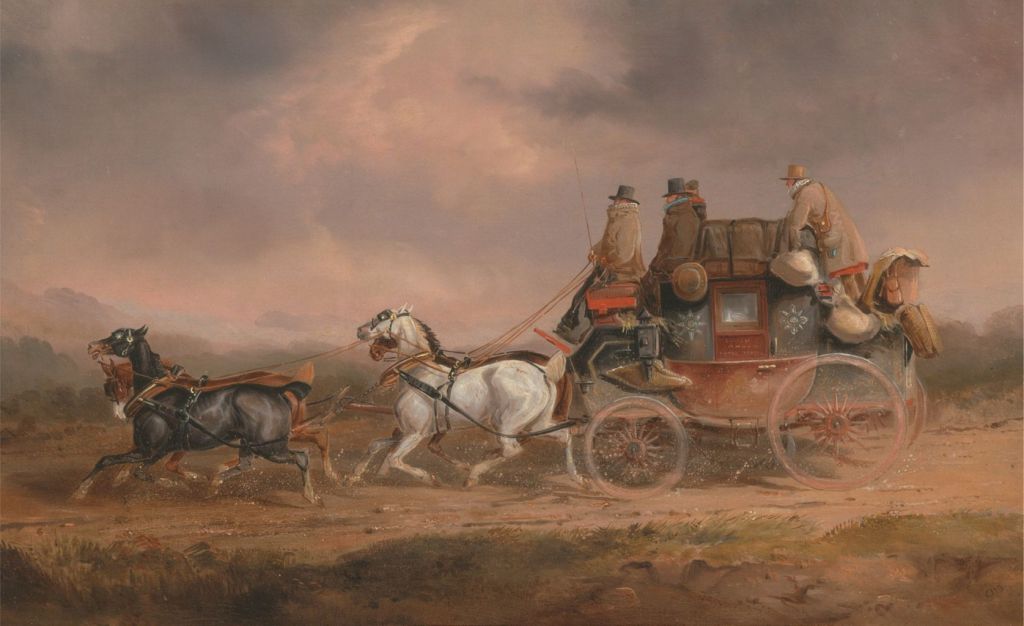
The hosting abilities of Mr Nicholson do not appear to have been in doubt as many complimentary reports appear in a similar vein to that below:

Alford postal services continued to expand, an improvement that Drakard’s Stamford News attributed John Nicholson, who had persuaded the General Post Office to increase funding enabling both the up and the down mail coaches to be met.

Despite the apparent success of his tenure as a landlord within a few weeks of the increased funding for the mail operations William Smith became the Landlord of the Windmill Inn. John Nicholson remained Postmaster having relinquished his responsibilities as a landlord he ensured that he was in a position to undertake the extra trips to meet the mail coaches himself.
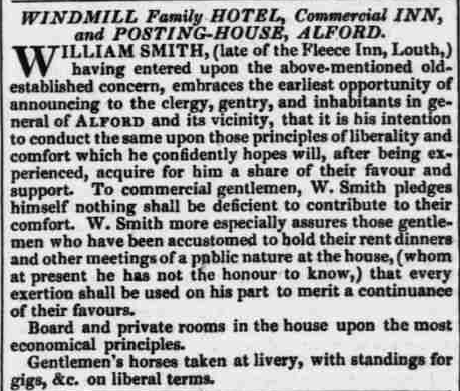
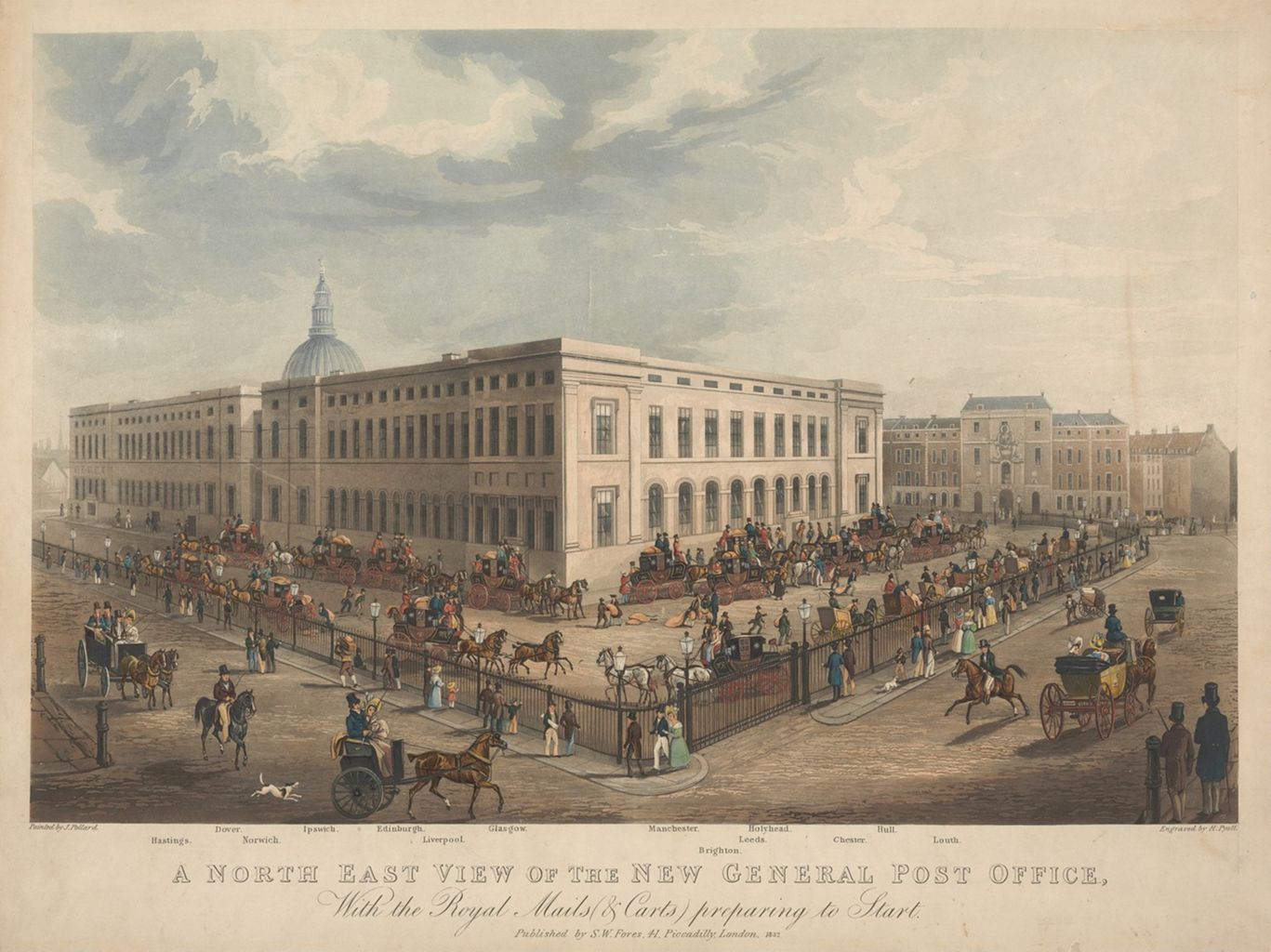
There was a romance about the mail coaches during this era. The spectacle of the Royal Mail Coaches leaving the General Post Office in London drew large crowds. The black and maroon coaches sped through the Countryside, the drivers pushing on to meet their deadlines, the post must be delivered at all costs.
The drivers and horses were changed enroute but the guards stayed with the post for the entire journey, tasked with the responsibility of getting the mail to its destination regardless of mishaps along the way. When accidents and bad weather caused disruption the guards were under strict instruction to protect and deliver the mail. In December 1836 particularly heavy snow falls rendered all roads around Louth impassable for days. The London mail coach was overturned at Driby and had to be abandoned. The guard delivered the mail in a post-chaise, an event captured by James Pollard’s series on the 1836 Winter Snow. On other routes National papers reported guards walking for miles to deliver the mail bags, prompting the GPO to announce service awards.

The Mail Coaches not only delivered the post they distributed the news, the guards in particular were well placed to pass on important news from the Capital. Royal Mail guards were the popular celebrities of their day.
Sidney Sutton from Barton on Humber had worked as a guard on the Express Coach, by November 1837 he had become the licensee of the Windmill Inn. William Smith had assigned his debts to his creditors some months before. The Windmill remained a Posting House, John Nicholson was still the Postmaster, he had also become an appointed tea dealer and a Fire Insurance Agent, it is unclear whether he continued to work from an office at the Windmill or elsewhere. Nicholson was clearly very proud of his role as Postmaster it was a responsible position which enabled him to make good connections locally and ensured his involvement with the popular Royal Mail Coach Men.
In 1839 the following death notice was published:
Aged 76 Mr Jos Jackson was for [nearly] 20 years guard of the London and Louth Mail, prior to which he, for 30 years, contracted for conveying mail from Boston to Alford … performing the principal part of the duties himself daily on horseback. Being before the public for 50 years he was almost deemed a public character, and was highly esteemed for his industry and integrity.
Stamford Mercury 13th Dec.1839
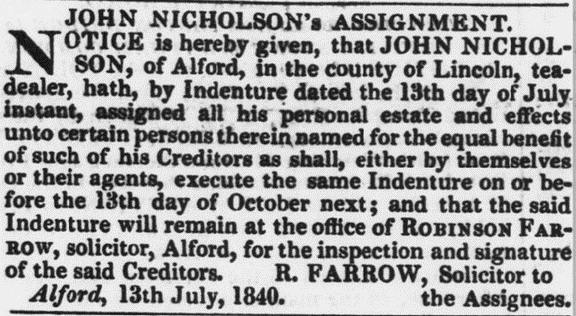
John Nicholson must have known Mr Jackson and it can be imagined that he would have hoped to have been so well thought of in Alford and surrounding areas. However this would not be the case, a few months later another notice in the Stamford Mercury reported what many already knew, John Nicholson was in financial trouble, it was the beginning of his downfall.
By the end of the month newspaper reports from the Lincolnshire Assizes reveal the extent of his problems.
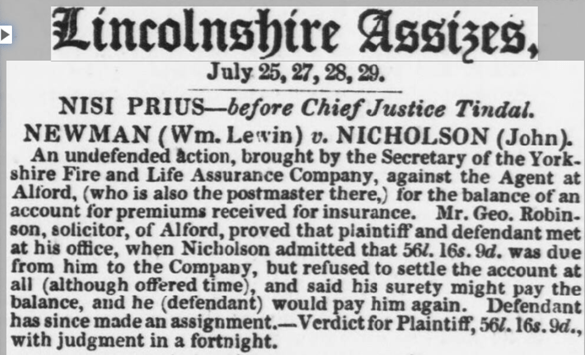
John Nicholson, Postmaster of Alford, struggled on for two years trying to get beyond his money troubles.
An Extraordinary Case
In October 1842 Mr James Peoples of Letterkenny, Ireland posted a letter from Sheffield to the Postmaster of Letterkenny. The letter contained two (dexter) halves of banknotes. The advised “secure system” of the day for sending money through the mail (3). The following day Mr Peoples sent the remaining (sinister) halves to the same address from Manchester. The latter item was not received.
On the 1st November Messrs AB Savory and Sons, well known London Silversmiths received a letter from Mr Dyson of Mablethorpe requesting items of Silver Plate to be sent immediately for his daughters marriage. The letter contained the sinister halves of a twenty and a ten pound note, the dexter halves were to be forwarded upon receipt of the goods. Having provided the goods, the change, and a letter to Mr Dyson. Messrs Savory were disappointed not to have received the dexter halves by return and subsequent letters received no response. Having first contacted the Bank of England, they proceeded to contact a trusted gentleman in Alford to make enquiries on their behalf.
The Alford Postmaster, who held responsibility for Mablethorpe deliveries, was the first port of call for those enquiries. Mr Nicholson was astonished and quick to respond” What will they think of next ?” He had, he explained, already returned the letters sent to Mr Dyson to the “dead letter” office as he had been unable to trace him. Mr Nicholson then proceeded to make extensive enquiries himself.
On 24th December the legitimately received dexter halves were presented to the Bank of England by Messrs Jones and Lloyd Bankers. The General Post Office were fully apprised of the matter and Mr Robert Peacock(4) (assistant solicitor, GPO) tasked with investigating the incident, travelled to Alford. When questionned Mr Nicholson stated that he had no recollection of seeing the box from Messrs Savory. The same evening a note was sent to Mr Peacock that a box of silver plate addressed to a Mr Green of Mablethorpe was at Louth Post Office.
Messrs Barker and North of York had received a letter from a Mr William Green of Mablethorpe, dated Dec. 28th 1842, requesting a quantity of plate be delivered to him care of Mr Hunter, with instructions for it to be forwarded by Royal Mail. A bank post bill for 29L 8s was enclosed. Mr Mitchell, the Louth Postmaster at the Mason’s Arms received the box but resolved to forward it later by carrier. In the interim Mr Hunter heard of the box and called to collect it, not expecting any such delivery he refused to pay the 2s 6d for carriage and demanded that the box be opened. Mr Mitchell and Mr Hunter were astounded to find silver plate, Mr Hunter quickly demanded it but his request was refused. The Louth postmaster wrote to York to establish more facts on the matter.
Mr Peacock had also been informed by the London to Louth guard that the box from Savory had been delivered to Alford. Peacock was an old hand at such matters. He discerned that the letter sent to Messrs AB Savory in London, purporting to be from a Mr Dyson, was written by the same hand as the letter sent to Barker and North of York allegedly from a Mr Green. Mr Dyson and Mr Green did not exist, the letter from William Green had been retrieved, it bore an Alford Postmark. The bank post bill sent to the York Silversmith had originally been enclosed in a letter posted in London to Mr Morrison, Upperhaugh, Alford, Aberdeenshire. The name of Mr Morrison had been forged on the endorsement. Alford was central to the whole affair.
Mr Peacock began to suspect that John Nicholson had a hand in the scheme and his house was searched. A defective stamp was found which matched the impression on the letter sent to Messrs Savory. John Nicholson, the proud under-butler, popular landlord and long serving postmaster was arrested.
On 24th January 1843 John Nicholson appeared in front of magistrate Mr John Fytche charged with the robbery of bank notes and fraudulent obtainment of silver plate.
Nicholson stated[that] the box had been in his possession nine weeks, and no enquiry having been made after it, and not being able to find any such person as Dyson living at Mablethorpe, he thought it was almost his own and therefore had a fly at it … he then described having packed the plate up in a little hamper, placing a hare on the top of the silver as a present to his friend and sent it on the 16th January to Herman Boss, working-jeweller, of Louth, having previously written a note to the effect that, having declined public business, he had no longer occasion for the plate, and wished them to let him know what they would give him per oz. for it. They replied 5s.9d. a note in the hamper requested Boss and Co. to send the value of the plate by return. 27th January 1843 Stamford Mercury
The contents of the box from Savory were also listed in the report: 12 silver table-spoons, a pair of gravy-spoons, 1 dozen tea-spoons, half a dozen dessert-spoons, a butter knife, a pair of sugar tongs, and four salt-spoons. An inconspicuous selection designed to be easily sold on. Nicholson was held in Lincoln Castle Gaol to await further witnesses from London, York and Ireland. The extraordinary case of the Alford Postmaster was National news.
On 4th March 1843 the case was heard at the Lincoln Assizes, the Jury found John Nicholson guilty and the Judge stated that he deserved the harshest sentence he was able to give, transportation for life. Prison records reflect a man of bad character, ruddy faced, balding with some grey hair and a black eye. In April John Nicholson was tranferred from Lincoln Castle Gaol to the Prison Hulk The Warrior at Woolwich to await transportation.
The Warrior


It was from the Warrior Hulk at Woolwich that John Nicholson wrote his letter to Lord Worsley, he turned to his current situation towards the close of the letter.
If your Lordship would use your Lordships influence with the Right Hon. Secretary of State of the Home Office for the mitigation of my sentence and to act for my remaining in this Country I may live to rejoin my distressed family, and offer up prayers with them to Almighty God to shower his blessings on your Lordship and his family. I would further state to your Lordship that I am upwards of 57 years of age and, from an injury I received while driving the mail, I am incapable of using my right arm in any manual labour that requires much assertion. I have during the time I have been at Woolwich been in very bad health being 19 weeks out of 7 months in the hospital where I still remain. … I trust your Lordship will excuse the liberty I have taken in writing this long letter. I have been given to understand the present uncertainty of these hulks remaining as receptacles for convicts, it may give a greater certainty of success to your Lordships application … for mercy on my behalf, fully hoping that your Lordship will give this application a favourable consideration. I subscribe myself my Lord, your Lordships most obedient humble servant
John Nicholson
Warrior Hulk, Woolwich, Kent
Lord Worsley replied from Manby Hall on the 30th October, he made the point that an example must be made of men who perform such a serious breach of trust, but went on to advise that he did not feel it was improper, in consideration of his age for Nicholson to serve his life sentence on the hulk. Prison records noted that he was to be detained in England.
The reprieve did little to help John Nicholson, sentenced to remain in the brutal disease ridden confines of the hulk among 600 other convicts he finally accepted his situation. Within a month of Lord Worsley’s letter John Nicholson was dead. On the 2nd of December 1843 the West Kent Guardian reported on his inquest. Several lines addressed his crime, far less the cause of death. The ship’s surgeon stated that since his arrival on the hulk John Nicholson had fretted exceedingly and then died “of a broken heart“.
Post Script
In 1844 Herman Boss the Louth Silversmith was arrested amid great commotion and charged with receiving stolen goods in a separate affair.
In 1847 the House of Commons continued to debate the terrible conditions on the Prison Hulks at Woolwich. Beyond many new prison regulations and inspections convicts endured the harshest, filthiest regime. A regime the house had agreed should die out in 1843.
In 1850 the Alford diarist Robert Mason saw fit to record the death of Eleanor Nicholson and in doing so preserved his own judgement on the family.
Mrs E Nicholson, widow of John Nicholson late of the Windmill Inn.
Sept. 29th 1850
This dear woman had passed through a sea of trouble. The husband was a most abandon character and was given up to work ingeniously with all greediness. He was arrested by the law and stopped in his mad career for swindling. The widow supported herself and family by selling pots of confectionary a more industrious and laboursome woman could scarce be found. The most remarkable feature of her life is yet to be told for suffering does not always lead [down the right path]. She had lived after the world and there was reason to believe that she had not adhered to chastity, for her late husband encouraged her for the sake of gain in her awful pursuits.
After the loss of her husband her two sons were removed to York so that they might be able to provide for themselves by learning . While there the eldest was converted to God, then Henry was converted and wrote home to their parent informing what God had done for those souls. Best of all the mother was led to the house of God, a place where she had scarce ever been before. About 12 months ago I witnessed the most interesting sight I ever beheld , two of her daughters in their bridal attire and their mother at a penitent pew in the Methodist Chapel seeking for mercy. God was found with them and she with her daughters was made happy in the Lord. One daughter emigrated the following day for Port Natal. R Mason’s Diary Sept. 1850
Notes:
- In 1825 the list shows John Nicholson, Alford, proving that this is the correct person. Another John Nicholson, an Attorney, is also present throughout this period in Brigg.
- Lord Yarborough, the first Baron, died at his home Brocklesby Hall in September 1823 aged 75 years. He was succeeded by his son, the second baron, who would become the first Earl of Yarborough in 1837, this is the Earl that Nicholson suggests may recall his service to his family. Lord Worsley is the Earl’s son and heir, his reply is sent from Manby Hall.
- Theft from the mail was commonplace, the following notice (1792) explains the recommended method for sending half bank notes:

- Robert William Peacock joined the Solicitors branch of the Post Office in 1827 and would attend to criminal prosecutions against the Post Office acts for the next 48 years.
Never had the Crown a better servant. He acquired in court a solid reputation, for the briefs which he prepared were unassailable —every fact could be established, no link was omitted. source: Forty Years at the Post Office. FE Baines 1895
 About Alford