

In December 1823 the Morning Chronicle reported the murder of Sarah Arrowsmith of Alford. Mr John Smith had been charged with mixing arsenic in a grinding of flour and presenting it to Sarah, the mother of his son, Hennan Arrowsmith.
The shocking transaction has excited a very strong sensation throughout the County, and is the subject of general conversation in every town and village.
In the annals of murder it would be difficult to find an instance in which the plan and execution of the crime were laid and consummated with more cool deliberate villainy. The Morning Chronicle Sat 18th Dec. 1823
Sarah was close to giving birth to Smith’s second child and becoming more insistent upon the marriage Smith had promised her prior to Hennan’s birth. Despite telling Sarah that he would publish the banns Smith had declared to others that he was decidedly averse to the marriage. On the 4th December Smith had visited Sarah informing her that she should eat no more oat cakes, as they did not do her or the child any good, he promised to bring her a grinding of flour. Shortly before this visit Smith had purchased a large quantity of arsenic from the druggist at Alford.
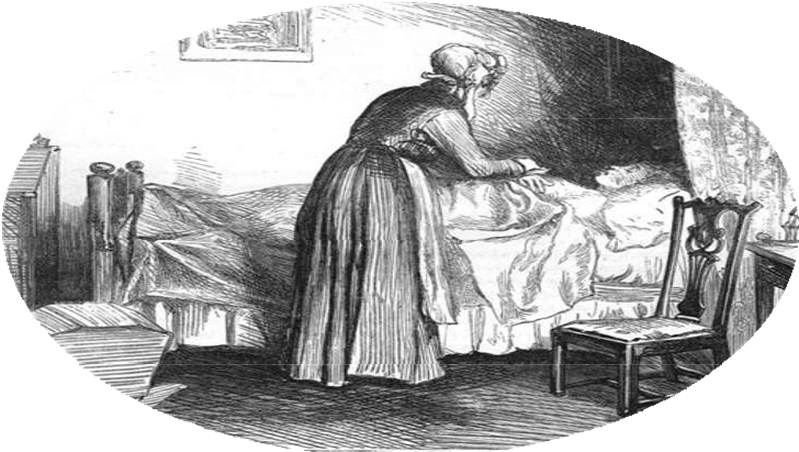
John Smith delivered the flour to Sarah early on Monday the 8th December, via a ptchfork to her bedroom window, as the two did not inhabit the same house. Sarah invited Smith’s sister to tea, making cakes for herself, Hennan, her two younger sisters and a neighbour. All of the party fell ill very quickly and local medical men were called. The six people were found to be in agony, suffering convulsions and apparently dying.
The eagerness of the inhabitants of Alford and the neighbourhood, of every class, to see Sarah was so great that crowds forced themselves into her bedroom and such was the weight and pressure on the floor of that apartment, which was supported by only one cross joist, that it snapped in the middle and had not every person, except the sufferer who was in bed, made a hasty retreat the floor would have fallen in and occasioned serious and perhaps fatal consequences to those in the room below. Props were procured to support the ceiling and no further damage was sustained. On the following day Sarah Arrowsmith, after enduring the most dreadful agony expired in a convulsive fit and a Jury was instantly summoned. The Morning Chronicle Sat 18th Dec. 1823
John Smith Sentenced
Sarah died on December 11th, during her final hours a deposition had been taken to establish the events of the previous three days. Smith had been brought to her bedside by the constables, having given her version of events she continued to assert his innocence in the matter, stating that it could not have been him that poisoned the flour, he readily agreed.
John Smith was taken to Lincoln Castle to await trial. In March 1824 John Smith appeared before the judge at the Chapter House in Lincoln. The many professional witnesses from the three days prior to Sarah’s death were called, including the Alford druggist, and the two surgeons, Mr Tyson West and Mr Pell. On passing the sentence of death Mr Baron Hullock observed that Smith had been convicted on the clearest testimony of the foul crime of murder. The course he had pursued had not only destroyed the immediate object of it , but had nearly involved the whole family in destruction. Smith was sentenced to hang afterwards his body was delivered to be dissected and anatomised.

John Smith was hanged on the roof of Cobb Hall at Lincoln Castle on Monday 15th March 1824.
Public executions drew large crowds, they took place at Cobb Hall from 1817 to 1859 having previously taken place on Westgate. Private hangings took place within the Castle grounds from mid-August 1859.
 About Alford