
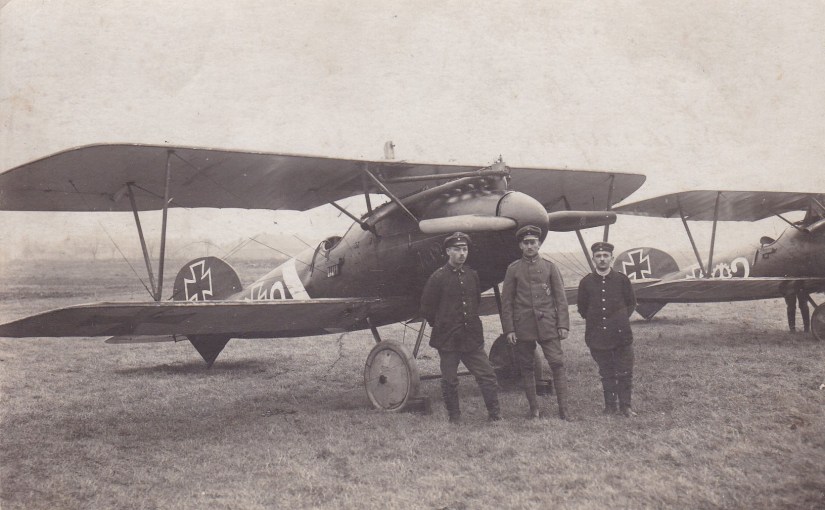

So many brave young men lost their lives fighting for their country during WW1. The postcards below tell the story of German pilot Karl Eisele, ancestor ( Great Uncle) of local businessman Harry Dewick-Eisele.
Extracts from the diary of Jasta 43 pilot, Josef Raesch provide an insight into the lives of the German pilots.

Karl Eisele was born on 25th March 1892 in Ludwigsburg. When Germany declared war on Russia, 1st August 1914, Karl joined up to fight for his country, he was 22 years old. Travelling on a Zeppelin Z7 he wrote home requesting that his mother send his things immediately.


In June 1915 post cards home place Karl in training at Johannesthal airport, near Berlin.
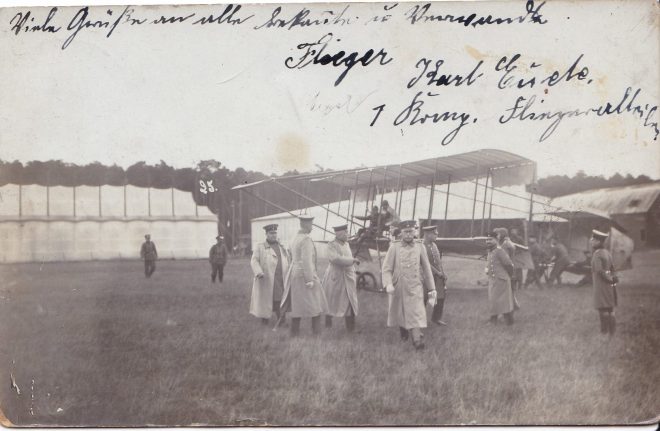

The early postcards suggest that Karl is continuing to live the life of a young single man, they contain appeals for funds, ostensibly for new hats and outfits, although the requests are relatively frequent.

In December 1915 Karl sent the above postcard to his brother Eugen Eisele. At the time Eugen was being transferred from the Eastern Front, where he had been fighting the Russians in Poland, to the Western Front again. The card was returned to Karl.

Karl is in the centre of this group. He was stationed with 4.OHL Staffel Kampfstaffel 23, where Lothar Freiherr von Richthofen was also serving, a brother of the ‘Red Baron’.

This photocard was sent to Karl from a nurse (Sister Gertrud) following his release from hospital. Gertrud hopes ” that he is not causing too much mischief in Cologne!” and reports that the air attacks on them have died down a bit.

Sister Gertrud sent this card to Karl for Christmas, he is now back at his Staffel.
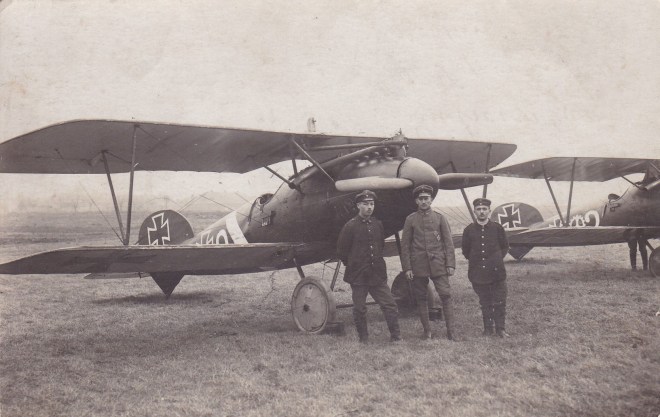
The final card from Karl is dated 16th December 1917 it was sent to his parents, he is in the centre of the group. Karl was with Jagdstaffel 20, a fighter squadron.

Two weeks later, on 30th December1917, Karl was killed when his aeroplane, an Albatros D3, crashed at Metz. He was 25 years old.
Vizefeldwebel (Sergeant 1st class) Karl is buried in graveyard near Metz with what is reputedly a propeller as a cross. At the time of his death Karl was at Jagdstaffel 43, a unit only created 24 days before Karl died.
Karl’s Fighter Squadron – Jagdstaffel 43
50 years later the “Cross and Cockade” magazine published extracts from the diary of Josef Raesch a fighter pilot assigned to Jasta 43 in June 1918.
Although written several months after the death of Karl the diary offers some interesting insights into Jasta 43 fighter training and more generally life as a pilot in a German fighter squadron. It captures the humanity of the pilots.
Extracts from the diary of a Jasta 43 pilot
27/06/1918
We took off with Jasta 14 … we noted that our Flak units were firing away at a squadron of English fighter planes. The S.E. 5s Camels were at our altitude and Gutknecht signalled for an attack….
The SE 5 went into a climb and I now I could see the machine was on fire. The machine spun toward the earth in a tower of fire and finally crashed. I then flew home and reported this, my first victory.
As soon as I landed, I commandeered a car and drove to North Hantay.
It did not take us long to find the remains of my victim. The pilot was burned beyond recognition and was still lying in the debris. It depresses me very deeply and takes the joy out of the victory.
Throughout July 1918 Josef becomes increasingly critical of the mechanical failures and training within Jasta 43.
20th July 1918
The British respect and celebrate Sunday by staying on the ground. Battles on the ground as well as in the air show how very superior the Allies have become. It is very discouraging! It is also the reason we have become so eager.
We believe that our effort makes up for the disadvantages, but our gasoline provisions are now extremely low and are being rationed to us.
Our motors are more susceptible to malfunction, our ammunition is no longer made from brass, but from iron, and substitute material is being used in our fuel lines.
The many failures with ammunition and engines can be traced to this desperate situation. The possibility for successes becomes poorer all the time. We understand that wooden wheels will be substituted for our rubber tires in the near future. This will bring many nose-overs and accidents that will only end up in a shortage of machines.
While there is a good supply of flight personnel, they lack combat experience. The Englishmen appear to have more tactical background in formation, aerobatics, and combat flying due to their instruction and the experience of their commanders.
Jasta 43 has qualified pilots with plenty of initiative and who are ready to do combat, but we have only shot down a few enemy aircraft.
Despite his great courage Oblt. Gutknecht has only a few air victories and lacks the experience of demonstrating to us how to be masterful when we contact the enemy.
With the personnel that we have, we could be one of the more successful German fighter squadrons if only we had additional training.
25th July 1918
Early Eve Sortie with only five planes, due to damage inflicted in combat, six machines remain in a state of repair. Near La Bassee a flight of SE 5s jumped us and we began evasive action to do combat.
I glanced over my shoulder, then kicked rudder and stick to my left as there was an Englishman on my tail. My manoeuver led me into the sphere of his deflection shots because Buckingham ammunition passed by my head, entering into my machine.
Now my machine was burning. A blazing fire hit my face, I could not see anything because of the smoke and flames and I felt my flight boots beginning to shrink.
I had a feeling that I was lost, and immediately, my parachute came to mind. I have carried one for the past 14 days and, having the hope to live, I looked for the release pin, but I could not find it in the excitement. At last I had it and pulled it out: then dropped over the side, hoping that I would not foul in the tail.
At about 3700 meters I fell through the air. My goggles were black with smoke, so I pulled them off and saw, for the first time, that my chute had not opened.
I fell like a stone, and fighting for my life, I reached behind me and started stripping the chute out of the container when it popped into a full canopy with the sound of a cannon shot. With a jerk, the shrouds pulled tight …and I floated slowly down to earth.
16th August 1918
Around noon we really had an experience. More than 80 E.A. arrived above our airdrome and in spite of heavy AA fire, they dive bombed us and fired incendiary ammunition at our hangers and airplanes.
We ran out of our mess hall onto the field. Flames were everywhere. Two mechanics were injured. Three of our planes including my Pfalz were burning. At Jasta 63 many planes were also badly damaged.
17th August 1918
The second big assault by the English took place today. This time they attacked Jasta 40…almost all the planes were destroyed or damaged. Without a doubt the enemy is planning an offense and wants to annihilate the resistance of the German fighter pilots in the air.
28th August 1918
The big offensive of the Allies has begun against our 17th Army. The Tommies are attacking without interruption. When will we receive machines; and after they are here, will it take another 14 days to ready them for the front and try them out?
2nd September 1918
We still do not have machines and we are lazily lying around. There isn’t much to do except visit different Staffels….There is a lot of shoptalk that our Jagdgruppe is not being expertly led.
The British are superior to us, not only in number, but in their tactics and organisation. The staffel should fly in echelons, and there should be more staffels in the air at the same time in order that they can help each other.
There is also a lack of communications within the group regarding past experiences of combat with the enemy. There is talk that a successful fighter pilot should take over command. Tension exists in our Jasta.
Due to food shortages the men formed a procurement council in September, with each man contributing a fixed amount to a supply master for the purchase of provisions.
Throughout October Josef continues to report on his sorties and engagements.
On 9th November 1918 Josef and others travelled to Brussels to find new quarters as ordered. He reports official talk of an armistice.
10th November 1918
When we left the railroad station, we saw soldiers who no longer wore their cockade on their caps, they had their rifles hanging muzzle down and were annoying officers, tearing epaulettes from their uniforms. Before us was an unusual picture. Red flags were being waved everywhere. We tried to get away, and travelled the fastest possible way back to our staffel.
11th November 1918
We met Ruggeberg, Burberg and Bubenzer at the hotel Metropl, and, together we drove to the airodrome. When we arrived we found everyone nervous and in an uproar. About 100 meters away infantry passed while singing marching songs. Such contrast and the unfamiliarity with the city drove us half crazy. We warned our men to remain reasonable and loyal as they had been before. I could hardly sleep. I awakened time after time. The terrible happenings were haunting me……
What will happen now?
What will become of our Jagdstaffel?
These are the questions that occupy us now.
Nowhere is there any clarity. The war has ended.
Source: Cross and Cockade Vol 8 1967 Winter Edition: Diary of a Jasta 43 Pilot, Josef Raesch
 About Alford