
The serialised version of Smuggling Times and the truth behind the tales
The Poor : Harsh Reality

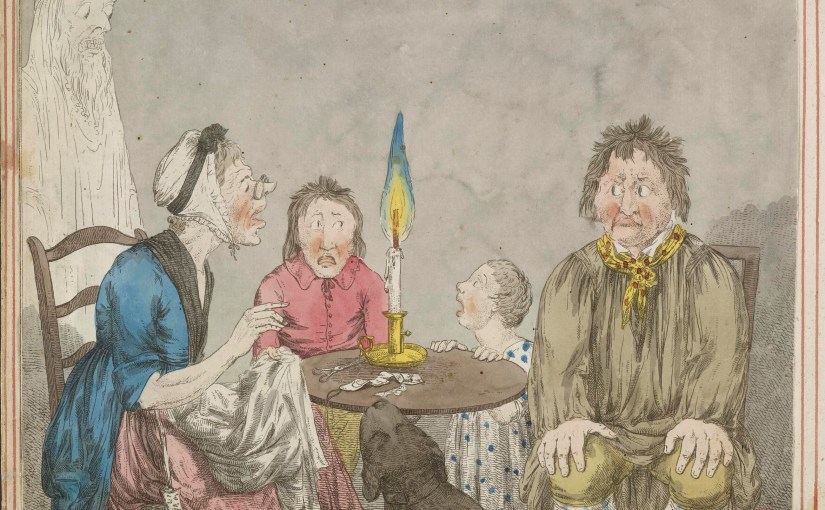
Charles Williams 1796 copyright Trustees British Museum
In 1788 a few days before Christmas, a labourer’s wife from Willoughby, stole a pound of candles from a local store. The goods were worth 6d, the young man in charge was not sure what to do but at the insistence of a local farmer’s wife the culprit was charged.
Nelly Coupland spent Christmas in Louth House of Correction waiting for her case to be heard. On 13th Jan. 1789 she was found guilty at Spilsby her sentence was as follows:
… to be recommitted to the House of Correction at Louth till Monday 16th February next, to be then brought to Spilsby, the next day taken to Alford and there publickly whipt from the prison round the sheep market to the church yard gate, and from thence to the water and back again to the prison through the Market Place and there discharged Bill Painter LNALS Louth House of Correction
Nelly was to be humiliated, whipped while she was walked through the town on Market day. 18th c. punishments were victim led, those convicted were shamed for public spectacle. Despite living within the parish of the Reverend Gideon Bouyer Nelly Coupland could not be protected from the law of the land.
The Parish Workhouse
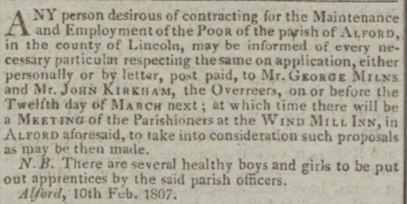
Life was not much better for the poor who remained within the law, the old and infirm, children too young to work, all ended up in the parish workhouse.
A survey of the poor in 1791 recorded 188 families living in Alford consisting of tradesmen, common mechanics, shopkeepers, farmers, a few labourers and innkeepers for the 11 alehouses. The poor were maintained in a parish workhouse run by a paid governor. In 1791 Fifteen inhabitants were recorded; three children under 7 years of age and three between 7 and 15, the remaining inhabitants were simply declared old.
The report stated “The house is poorly run by an old lady who is virtually a pauper and unable to maintain good order or industry” …neither was the “neatness which discovers itself in some workhouses to be found here”
In reality those capable of earning money by industry did so beyond the reach of parish officials.
Alford: Early 19th Century
Over fifty years on from the first Lincolnshire Stuff Ball Alford remained in the grip of poverty and crime. Demobilisation at the end of the Napoleonic wars in 1815 released between 250,000 and 400,000 into the labour market nationally. Corn prices dropped, labour rates fell by around a third and the demand for labour was in decline as the additional work created by enclosure was coming to an end. The effects of enclosure remained, the population was increasing but labourer’s housing was diminishing. In 1832 the Reverend E Dawson of Alford wrote at length on the Causes of Pauperism for the Labourer’s Friend Society, directly substantiating his work with facts and figures from Alford and the surrounding parishes. Dawson closed his paper with the words …
I cannot but conclude, that … [just] as the demolition of cottages with land … has produced a great increase of pauperism, so pauperism has produced a great increase of crime .
The punishments for those stepping over the line continued to be harsh. In October 1839 John Wood (40) and Harriet Wood (15) were found guilty of theft from William Wilson, druggist, of Alford. The pair stole a quantity of tobacco, a hymn book and other articles. John Wood was sentenced to 2 months in Louth House of Correction with hard labour. Harriet received 6 months in Spilsby House of Correction with hard labour.
William Wilson was under pressure form various angles, in January 1843 he was the petitioner against bankrupt Thomas Charles Clarkson, a tanner of Lambeth. It appears that Mr Wilson had business contacts a long way beyond the boundaries of Alford.
Men of Influence : Men of good standing ?
The harsh realities of life in the Alford area, the opportunities provided by the nearby coast and the fear of the workhouse explain why many would become embroiled in the smuggling operations. The question remains who were the men controlling and organising the trade locally. A couple of events in the 1840s do provide information on one Alford man in particular.
On 27th September 1844 a large seizure of tobacco was made by the Excise on the premises of Messrs Garton, tobacconists, of Lincoln. They seized 720lbs of foreign tobacco. The bales had been landed on the Lincolnshire coast and made their way across the country by way of Horncastle to Lincoln. The Hull Advertiser reported that “they were brought by carrier and, after lying at a public house for some hours, placed in a cart in the midst of market day to be conveyed to Messrs Garton’s premises. Immediately the gates of the manufactory were thrown open, and the cart backed in, the seizure was made. Penalties were estimated to be nearly £400.
T and R Garton swiftly responded to the press reports writing to the Hull Advertiser the following week. They emphasised that the cart had arrived without their knowledge and they had nothing to do with the transaction. Furthermore they had found out since that ” the plot and conspiracy were laid by parties , one of whom is a druggist not 100 miles from Alford, the other two are ex-tradesmen well known in Horncastle and Louth and well known to the board of Excise. Two of them are exchequered under heavy penalties. It is strange that the board allow these worthies to go at large pursuing their collusive practises, namely to smuggle on the one hand and inform on the other. Inviegling unsuspecting people into their meshes for the purpose of victimising them out of their money and for an excise officer to lend himself to carry out their views [in order] to share in the fines is against the spirit of the rules laid down for his duty.
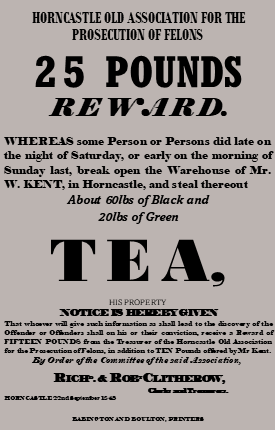
One year later the Horncastle Old Association for the Prosecution of Felons offered a 25 pounds reward for information leading to the conviction of those involved in a Tea robbery in Horncastle. 60lbs of black tea and 20lbs of green tea were stolen from Kent’s Warehouse. Privately the association wrote to Superintendent Casey at Alford and requested that a watch be put on two Alford men the parties having been suspected, for some time, of stealing tobacco. The party who conveys the goods away is no doubt your carrier Elvin. The party to whom they are sold is thought to be William Wilson, druggist of Alford. Despite lengthy surveillance the parties were not caught. Ironically the matter continued to rumble on into early 1846 when the Horncastle Association refused to pay the bill for the watch and Henry Titus Bourne put them in court for the non -payment of the bill.
Unlike the Woods family, who stole from his shop, William Wilson was not convicted, he may have had more influential friends. William Wilson provides the first tangible link to the men of influence in Alford who were involved in the trade, he was born in Grimsby in 1811, the son of an innkeeper, research continues but I suspect that Robert Roberts was quite right, everybody knew it !

 About Alford